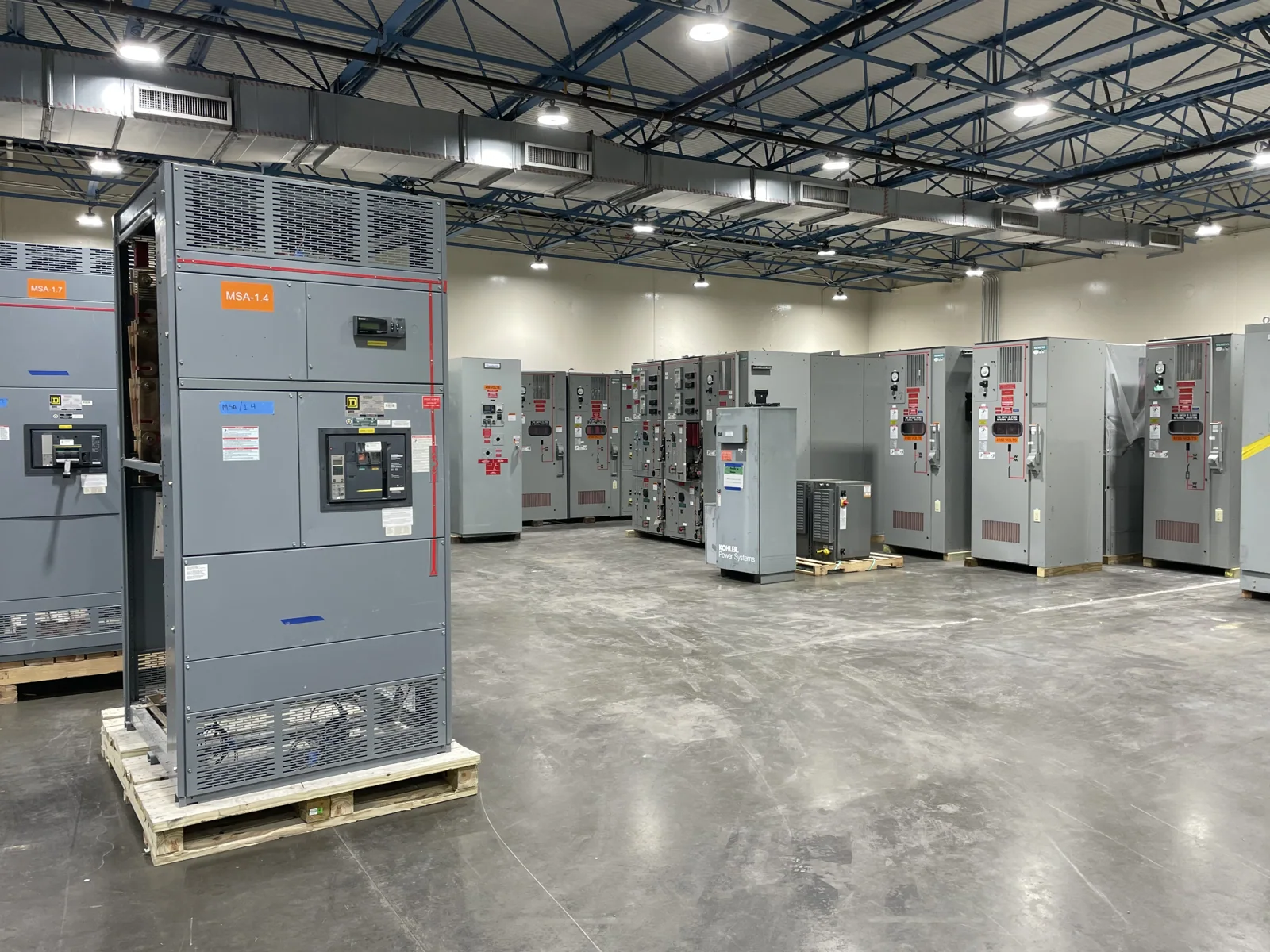
Sell Westinghouse Switchgear Lineups With Spares in Ohio
A Westinghouse marking can identify a switchgear lot, but it does not by itself establish a model, voltage class, compatibility, condition, affiliation, authorization or value. For an evaluation, describe the lineup sections, visible nameplates, device labels, stored breakers and every known gap. The buyer considers all voltage classes, including equipment released from decommissioned data centers and shut-down power plants. A seller does not need to test anything; an accurate record-based inventory is the useful first step.
Identification and documentation
From a safe exterior position, record the manufacturer marking exactly as shown, plus any readable assembly identification, section number, voltage, current, frequency, bus information and interrupting information. Photograph labels without opening compartments or operating anything. A lineup rating is not automatically the rating of every breaker inside it, and a device label cannot establish the rating of an adjacent section.
Existing drawings, one-line diagrams, equipment schedules, purchase records and maintenance lists can connect a section to its original lineup. Use them to identify uncertain associations, not to fill gaps with assumptions. If a stored breaker has no clear section reference, list it as an unconfirmed spare. Note unreadable labels, incomplete schedules, and ownership or release authority still being verified.
Completeness: lineup, devices and spares
Count each installed or stored section and describe its apparent function—main, tie, feeder or metering—only when documented. Separately count removable breakers, fuses, relays, control components, doors, covers and other loose pieces. A loose device is not automatically a spare for every Westinghouse lineup. A matching label, schedule entry or other record should support its association; otherwise mark the relationship unknown.
List absent covers, incomplete hardware, removed controls, missing shutters, damaged nameplates and empty positions. Distinguish the proposed lot from neighboring gear that remains in service. A complete-looking enclosure can have an incomplete device set, while a partial lineup with documented loose spares may deserve a different review.
Condition without seller testing
Condition reporting can remain observational. Note indoor or outdoor storage, moisture evidence, corrosion, impact, dust, paint loss, bent enclosure parts, visible damage and protective packaging. Describe whether loose breakers are tagged, palletized, boxed or mixed together. Do not open, operate, dismantle, touch energized equipment or perform electrical tests. Qualified, authorized personnel establish safe conditions and handle isolation when needed.
Age is relevant, but a dated record or visible label is more useful than an unsupported estimate. Mention known exposure to fire, flooding, contamination or prolonged storage, separating confirmed facts from unknowns. The buyer can evaluate uncertainty; concealing it makes the lot harder to assess.
Two hypothetical sale situations
Hypothetical situation one: organized data-center spares
Assume a decommissioned data center has two Westinghouse-marked lineup sections, three boxed breakers and a labeled hardware cabinet. The schedule associates two breakers with named positions, while the third has no matching reference. Call the first two documented spares and the third an unconfirmed device, rather than promising a fit. Exterior photos show dry storage and intact doors, but the interior condition is unknown. This clarity supports evaluation without seller testing.
Hypothetical situation two: mixed power-plant storage
Now assume a shut-down power plant has a longer Westinghouse-marked lineup, removable devices on pallets and loose covers in another room. Records identify main and feeder sections, but pallet tags do not consistently match them. One section has visible corrosion, and the release boundary excludes adjacent owner-retained equipment. Section-by-section labels, pallet-tag photos and an explicit list of unknown associations are more valuable than one total count.
What can affect a potential offer
Evaluation may consider verified markings, documented voltage and current, section count, device identity, completeness, physical condition, storage history, ownership clarity and the proportion of confirmed versus uncertain spares. Drawings, consolidated staging and specialized components can also matter. No price or compatibility should be inferred from a Westinghouse marking alone.
After reviewing the lot, the buyer can provide a cash offer; once the seller accepts and the sale is agreed, payment is made upfront before the agreed pickup. The seller is not expected to test the equipment or prepare a technical certification. Settle payment terms and the exact lot boundary before release, especially where landlord property, retained sections or utility-controlled equipment is nearby.
Worked inventory checklist
- Lineup identifier, section count and each visible section label.
- Westinghouse marking on each item, with unreadable text noted.
- Documented voltage, current, bus and interrupting information, with source record.
- Main, tie, feeder or metering description where the schedule supports it.
- Breaker and protective-device label, position association and confirmation status.
- Stored spares, covers, hardware and controls, including packaging and tags.
- Missing pieces, damage, moisture, corrosion, storage conditions and contamination.
- Ownership, retained equipment, authorized release date and access contact.
Access, release and freight planning
Share the release window, site rules, loading hours, floor or doorway constraints and approvals needed to enter an electrical room. These are coordination details, not a request for the seller to remove equipment. Qualified personnel handle isolation and disconnection; the buyer handles crane service, qualified disconnects, rigging, loading, freight and hauling. The seller should provide safe exterior photos and existing records only.
Before pickup, confirm included sections and spares, staging locations, and whether a crane or rigging route needs facility approval. Authorized contacts coordinate access and boundaries. Clear labels and honest unknowns help prevent a Westinghouse-marked lineup from being mistaken for a complete, compatible assembly when the actual lot is still being documented.