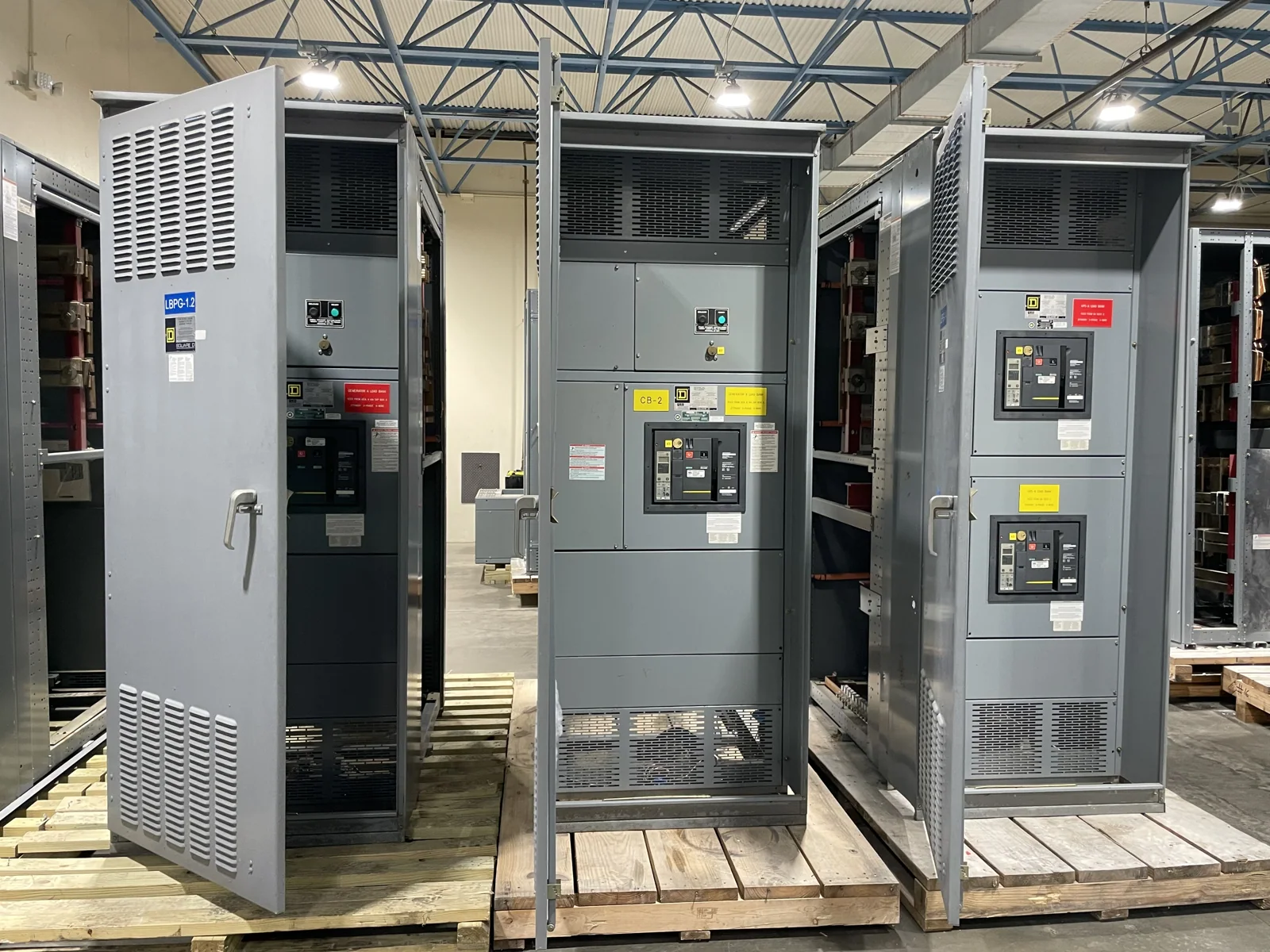
Sell Switchgear in Newark, Ohio: From Identification to Release
For a switchgear owner in Newark, a sound sale starts with a clear equipment boundary. The buyer considers all voltage classes, but evaluation depends on knowing what is available, what remains in service, and who may release it. A hypothetical facility upgrade could retire one lineup first and another later. Treat those as separate releases instead of calling the whole electrical room one lot.
1. Identify the Assembly
Use lineup labels, drawings, schedules, nameplates, and records already held by the owner. Record manufacturer, lineup designation, section count, documented voltage, continuous current, short-circuit or interrupting information, and documented dates. Do not infer ratings from cabinet size or a breaker’s appearance. An assembly rating describes the lineup or bus arrangement; an individual removable breaker has its own voltage, current, and interrupting markings. Those values can differ.
Separate main sections from feeder sections where records identify them. Note device labels without opening compartments or operating anything. List removable breakers by their markings and their documented section or position. Separately stored spares need their own lines: a loose device is not automatically compatible with every similar-looking position. If a label, drawing, or association is unknown, mark it unknown rather than guessing.
2. Establish Completeness and Release Stages
A useful inventory shows the lineup designation, each main or feeder section, installed devices, loose breakers, documented relays or controls, covers or barriers, and known omissions. For a hypothetical two-stage upgrade, make two release lists: “Stage A, sections 1–3, available after the first approved changeover,” and “Stage B, sections 4–6 plus stored breakers, available after the later changeover.” This example does not claim a particular Newark facility.
Match every stored breaker to a section, position, or drawing reference when records support the match. If a spare has only a handwritten tag, preserve that information and identify the association as unconfirmed. Identify equipment serving an occupied area so the sale boundary does not include a main, feeder, metering component, or protective device still needed. Confirm ownership and whether a landlord, utility, lender, project owner, or other party must approve release.
3. Describe Condition Without Testing
Provide existing records and safe exterior photos only. Useful views show nameplates, section labels, closed doors, exterior corrosion, dents, missing covers, storage packaging, and surrounding clearance. The seller is not asked to test, energize, open, dismantle, or touch the equipment, and should not remove a breaker for a photograph.
Distinguish documented operating history from present visual condition. State whether the lineup was installed, removed, or stored; whether devices are installed or loose; whether packaging appears intact; and whether moisture, dust, impact, contamination, or missing hardware is known. Unknown internal condition stays unknown until a qualified, authorized process establishes safe conditions. The buyer can account for uncertainty without requiring a seller-generated test report.
4. Understand Offer Factors
Value is not determined by voltage or manufacturer name alone. Relevant factors include documented voltage class, bus and device ratings, manufacturer and series, complete sections, matching breakers, protective devices and accessories, documented age or service history, visible condition, storage quality, and missing or unidentified parts. A coherent lineup with correctly associated spares may be more useful than a larger pile of unverified loose devices.
Logistics also inform evaluation: section dimensions, approximate documented weight, floor level, door and route limitations, loading restrictions, and each release stage. After reviewing the lot, the buyer can provide a cash offer; once the seller accepts and the sale is agreed, payment is made upfront before the agreed pickup according to the transaction terms. The seller is not asked to pay for testing, crane service, rigging, loading, freight, or hauling.
5. Coordinate Access and Safe Removal
Before release, identify the authorized site contact, ownership approvals, access rules, operating-area restrictions, and the date or sequence for each stage. Coordination ensures the buyer receives only released sections and associated stored breakers while the remaining system stays under the owner’s control. Access approval is a coordination item; it does not shift removal costs to the seller.
The buyer handles the crane, qualified disconnects, rigging, loading, freight, and hauling. Qualified personnel must establish safe conditions and perform required disconnection. The seller should not open equipment, work near energized parts, dismantle sections, or prepare a lift. Provide known travel-path and access constraints, then let the buyer’s team plan removal with authorized facility representatives.
6. Example Inventory and Seller Questions
Hypothetical example: an owner reports one main section, four feeder sections, two removable breakers stored in a labeled cabinet, and a later release date for the feeder group. The inventory should state which breakers are installed, which two are stored, and whether covers, barriers, and records are present. It should identify the first-stage boundary and exclude the section serving an occupied area until its separate release.
- What manufacturer, lineup designation, voltage, current, and protective ratings are documented?
- Which main and feeder sections are included in each release stage?
- Which breakers are removable, and which stored devices have a documented section match?
- What covers, barriers, controls, drawings, and schedules are included or missing?
- What exterior damage, moisture, contamination, or storage concerns are visible?
- Who owns the equipment, who authorizes release, and what access approvals are needed?
- What are the known dimensions, route restrictions, loading conditions, and release dates?
That sequence—identify the assembly, reconcile the lot, describe condition honestly, agree on the boundary, and coordinate safe access—helps a Newark, Ohio seller present surplus switchgear accurately without unsupported claims or electrical and rigging risks.