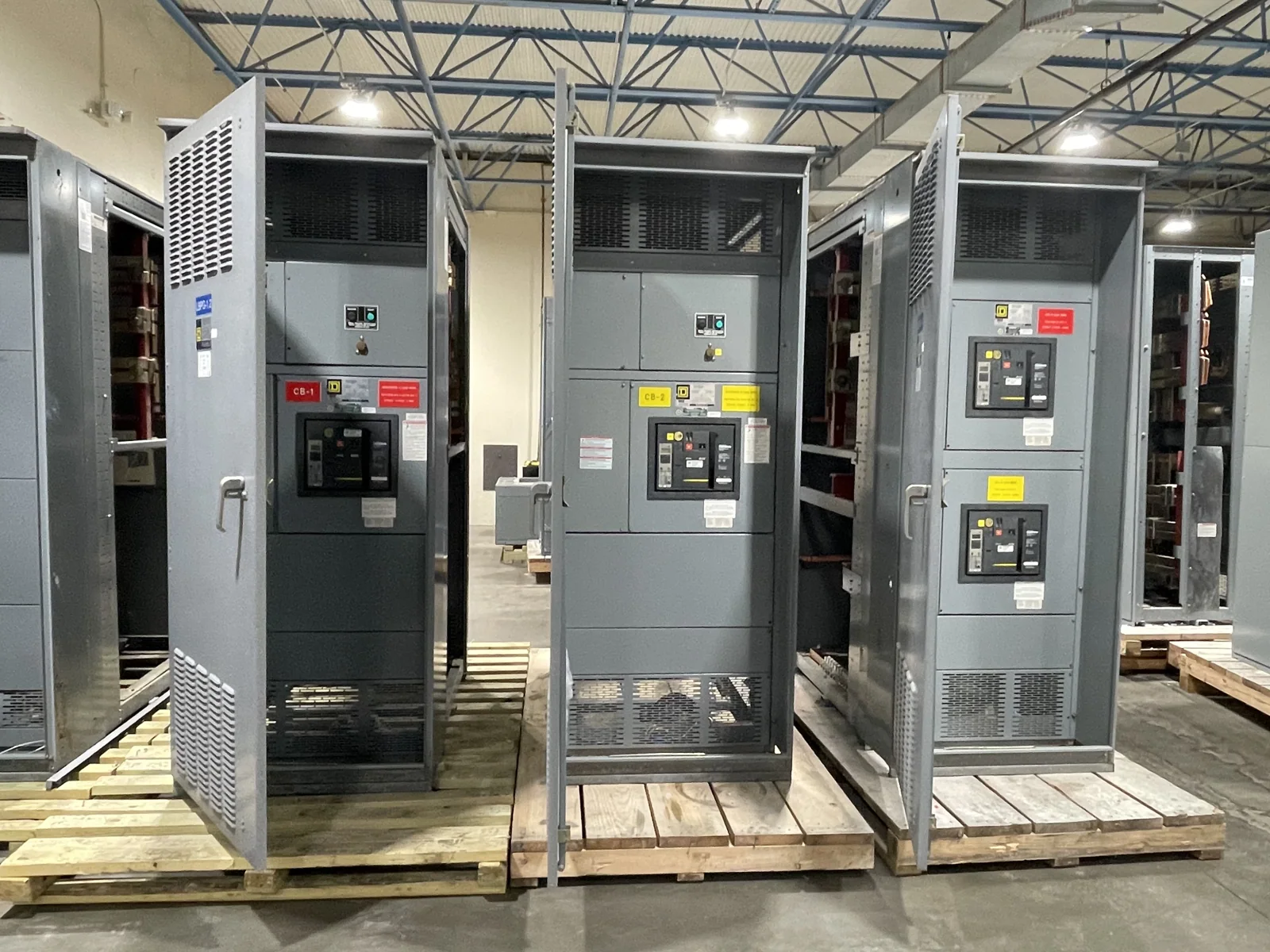
Hypothetical inventory scenario: A tenant fit-out in Dublin, Ohio is nearing turnover. One switchgear lineup will remain with the landlord, while another portion may be released. In the electrical room, a seller sees a main section, feeder sections, removable breakers on shelves, and a carton of older spares. That is a starting point, not a complete sale description. The central question is where the retained boundary ends and the sale lot begins. The business buys switchgear from facilities including decommissioned data centers and shut-down power plants, and considers all voltage classes.
Define the lineup before discussing value
Describe the assembly as an inventory, not simply as a metal enclosure. Record the lineup identification, number and order of sections, and visible main-bus or feeder labels. The main section may contain the incoming device, while feeder sections distribute power onward; those functions help match drawings, labels, and stored devices. Copy manufacturer and nameplate wording exactly when visible.
A rating belongs to a particular object. An assembly or bus rating is not automatically the rating of every breaker. An individual device rating and its interrupting rating are also separate. Share documented voltage, current, frequency, and short-circuit information when available. If a label is obscured or missing, call it unknown rather than guessing.
Clarify the retained boundary
In this hypothetical fit-out, the landlord may retain a lineup or defined section for future occupants while tenant-owned equipment sits nearby. Confirm authority before offering anything. Ask who owns the main section, feeder sections, removable breakers, control components, and loose spares. A lease exhibit, asset register, one-line drawing, or approved changeout scope may help, but note conflicts between records as unresolved.
List the proposed sale lot by section and stored item. “One lineup” is less useful than “main section plus feeder sections A through D, with two breakers stored in cabinet 3,” when those designations are documented. Identify equipment that must remain in service as excluded. Nearby utility-owned, landlord-retained, or active equipment is not included merely because it is adjacent.
Check lot completeness without disturbing equipment
Compare section numbers and breaker positions with schedules, drawings, packing lists, and maintenance records. Count removable breakers individually, recording visible labels and the section or position they are documented to fit. List spare quantity, label, storage location, and stated association separately. Do not infer compatibility because two breakers look alike; a spare with no reliable association is unknown.
Note covers, barriers, shutters, auxiliary compartments, relays, control-wiring documentation, hardware, shipping braces, and loose parts where records identify them. Missing trim or an absent device can change a section’s practical value, while a complete documented group may be more useful than unmatched components. If release is phased, list each group and authorization separately instead of combining future possibilities into one lot.
Describe condition factually
Use records and safe exterior observations. Provide known service and storage history, whether the equipment was operating or stored when last documented, and any recorded environmental exposure. Safe exterior photos may show nameplates, section fronts, breaker faces, cabinets, pallets, corrosion, impact marks, missing covers, or water staining. Existing inspection reports are useful when available.
Do not open compartments, operate handles, remove covers, dismantle sections, or test anything. A qualified, authorized team must establish safe conditions and handle disconnection. Report suspected contamination, fire damage, moisture intrusion, or unknown energized status plainly.
What can influence an offer
Valuation may reflect documented voltage class, manufacturer, section count, device mix, completeness, age, condition, storage quality, and whether the lot has a coherent configuration. Clearly identified removable breakers may add usefulness, while unverified loose devices may be valued conservatively. Ownership clarity and an authorized release date matter because equipment that cannot be released is not a ready lot.
Share existing records and request an evaluation; no seller testing is required. After reviewing the lot, the business can provide a cash offer; once the seller accepts and the sale is agreed, payment is made upfront before the agreed pickup. The exact offer depends on documented facts and the agreed lot.
Coordinate access and freight planning
Useful access details include the electrical-room location, door and corridor dimensions, floor or dock information, loading hours, security procedures, elevator limits, and the contact who can coordinate entry. For a tenant fit-out, identify landlord approval, tenant approval, outage coordination, and the precise release window. These are coordination items; they do not shift removal costs or technical responsibility to the seller.
The buyer handles qualified disconnects, crane arrangements, rigging, loading, freight, and hauling. The seller should not dismantle or move switchgear. Share safe, existing access information and exterior documentation so the buyer can consider section dimensions, weight records, lifting constraints, and the route to the loading point.
Example inventory and seller questions
Hypothetical example: “Lineup L-2: one documented main section; three feeder sections; two removable breakers labeled for F-1 and F-3; one stored breaker with unknown association; drawings dated before the fit-out; a dented lower door; landlord retains lineup L-1.” This separates known facts from unknowns and makes the boundary visible.
- Who owns each section, breaker, and stored spare?
- Which equipment is retained for the landlord or active service?
- What voltage, current, manufacturer, and device ratings appear on existing labels?
- Do schedules identify breaker positions and spare associations?
- What damage, moisture, contamination, or missing components are documented?
- Who can authorize release, coordinate access, and confirm the safe work window?
Send available records and safe exterior photos for the Dublin, Ohio inventory. The buyer can evaluate the lot without asking the seller to touch energized equipment or perform testing.