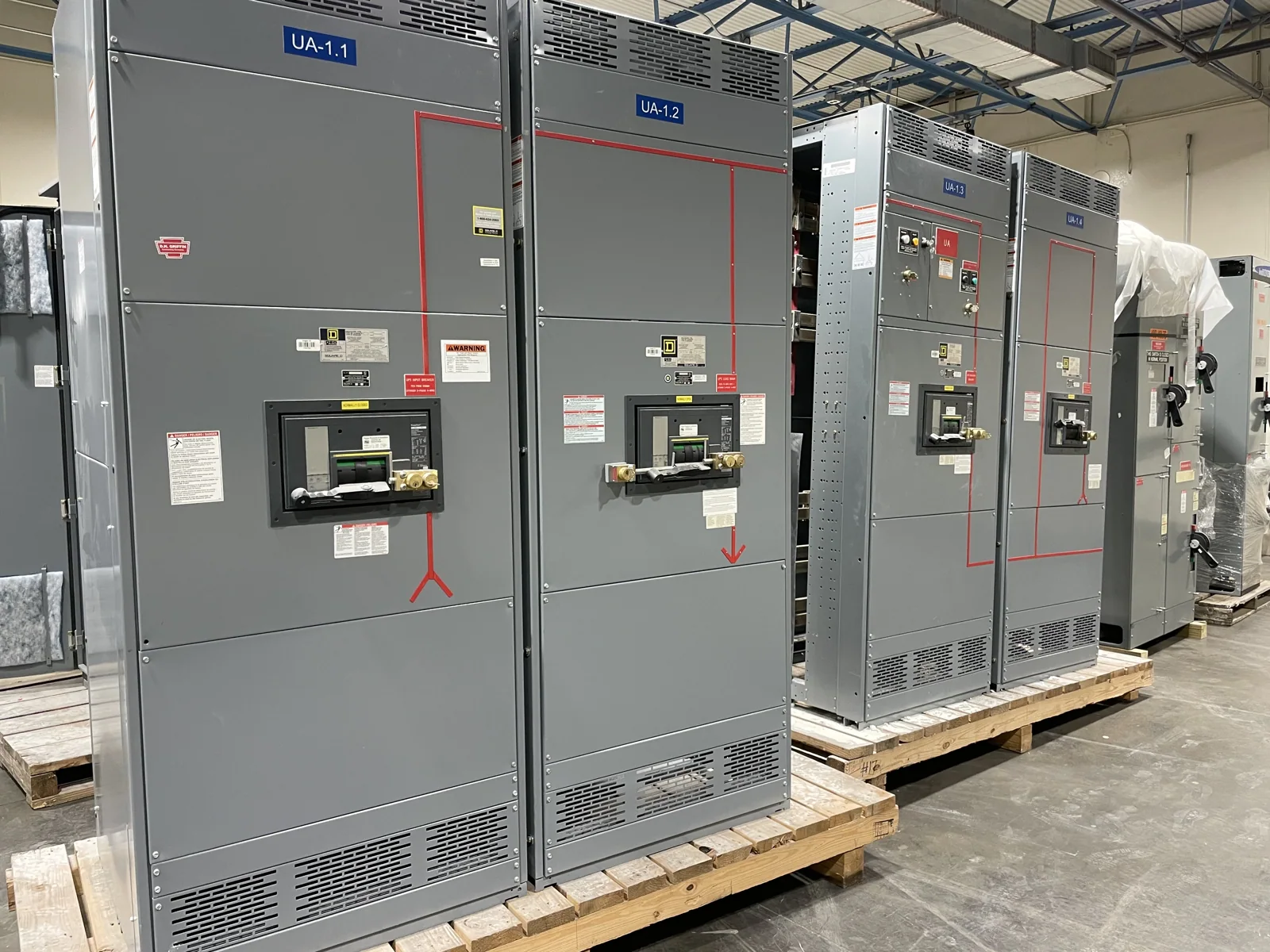
Evaluate the actual Schneider-marked lineup
A lineup changeout can create a valuable sale lot, but Schneider switchgear is only a starting point. A marking on one enclosure does not prove that every adjacent section, breaker, control component or spare belongs to the same assembly. For an Ohio site, begin with the proposed removal boundary: identify each lineup, section, device position and separately stored item the owner is authorized to release. Sections that continue serving building, process or utility-related loads must remain outside the sale unless the responsible owner changes that decision.
The buyer considers equipment across voltage classes, not just one assumed category. Records should state documented system voltage, phase information where available, continuous current, interrupting information and bus details exactly as shown on drawings or nameplates. Do not infer a rating from cabinet size, a familiar-looking breaker or the Schneider marking. A lineup rating, individual device rating and assembly interrupting information answer different questions. Unknown values should remain unknown until supported.
Identification and documentation that improve matching
Existing records are especially useful when a changeout involves equipment accumulated over several modifications. Gather available one-lines, lineup schedules, section labels, bills of material, prior inspection records and ownership documentation. Clear exterior photographs of each nameplate, door label and device face can help, provided they can be taken without opening equipment or approaching an unsafe area. The seller does not need to test, energize, operate or dismantle anything.
Compare records with what is visibly present. Record the manufacturer marking on each item rather than assuming a whole room has one brand. Note the lineup sequence, section identifiers, main device, feeder devices, protective relays, metering compartments and removable breakers. A loose breaker may be a spare, a replacement from another section or an unrelated item; its association should be supported by a tag, schedule or owner record. Do not invent a catalog number when a label is incomplete.
Completeness, condition and the changeout boundary
A potential offer depends on what can be matched and released as a coherent lot. List empty positions, missing covers, removed devices, loose hardware, stored controls and sections reserved for the replacement plan. Describe visible exterior condition: corrosion, impact, water indication, damaged doors, bent trim, compromised packaging or storage exposure. These observations are more useful than “good” or “used.” Do not open compartments; qualified, authorized personnel must establish safe conditions and handle isolation.
Hypothetical example: an owner plans to change out a Schneider-marked lineup with four visible sections, but one feeder remains needed until a later phase. The proposed lot is the three authorized sections, their documented removable devices and a separately stored breaker identified to one of them. The continuing feeder is not counted merely because it sits beside the others. If a drawing conflicts with a label, record the conflict rather than treating proximity as proof of compatibility.
What can affect a potential offer
- Match quality: consistent markings, section identifiers, voltage and current records, and documented device associations make evaluation easier.
- Completeness: a complete lineup with its identified main, feeders, covers and associated spares differs from unverified cabinets and loose breakers.
- Condition: visible corrosion, impact, moisture exposure, missing parts and storage method may affect valuation; unknown internal condition remains an uncertainty.
- Release authority: ownership, utility or landlord boundaries, continuing loads and required shutdown or access approvals must be resolved.
- Handling profile: dimensions, approximate recorded weights, doors, ramps, floor conditions and the route to loading help plan removal.
The buyer evaluates these facts rather than promising a price from a brand name alone. Schneider is a marking to verify on each item, not proof of affiliation, authorization, model compatibility, condition or value. After reviewing the lot, the buyer can provide a cash offer; once the seller accepts and the sale is agreed, payment is made upfront before the agreed pickup. No seller testing is required.
Worked inventory checklist for a changeout
Prepare one line per proposed item so the sale boundary is unambiguous:
- Lineup or section identifier and documented position in the assembly.
- Visible Schneider marking, nameplate wording, voltage class, current information and readable device designation.
- Main, feeder or other device role, with its associated section or position.
- Removable breakers, relays, meters, trip units and controls included with that section.
- Separately stored spares, with tags or records showing whether each belongs to this lineup.
- Known missing covers or components, exterior damage, packaging condition and storage location.
- Items retained for continuing loads and the authorized release date for the proposed lot.
- Dimensions, access restrictions, loading hours, escorts, badges and approvals needed for coordinated entry.
Access, safe release and freight coordination
Removal planning should describe the path from the equipment room or storage area to loading. Share known door widths, turns, thresholds, dock or ground-level access, lift restrictions, overhead concerns and site rules. These details support coordination; they do not ask the seller to move equipment or absorb removal costs. The buyer handles crane needs, qualified disconnects, rigging, loading, freight and hauling. The seller identifies ownership, provides available records and coordinates authorized access and release approvals.
Before handling, qualified authorized personnel must establish safe conditions and complete isolation. Do not open, operate, dismantle, touch energized equipment or perform tests for an evaluation. Once the boundary, records, condition notes and access plan are agreed, the buyer arranges removal sequence and freight details with site contacts. This protects continuing loads while giving an Ohio seller a document-based path to discuss a Schneider-marked lineup changeout.