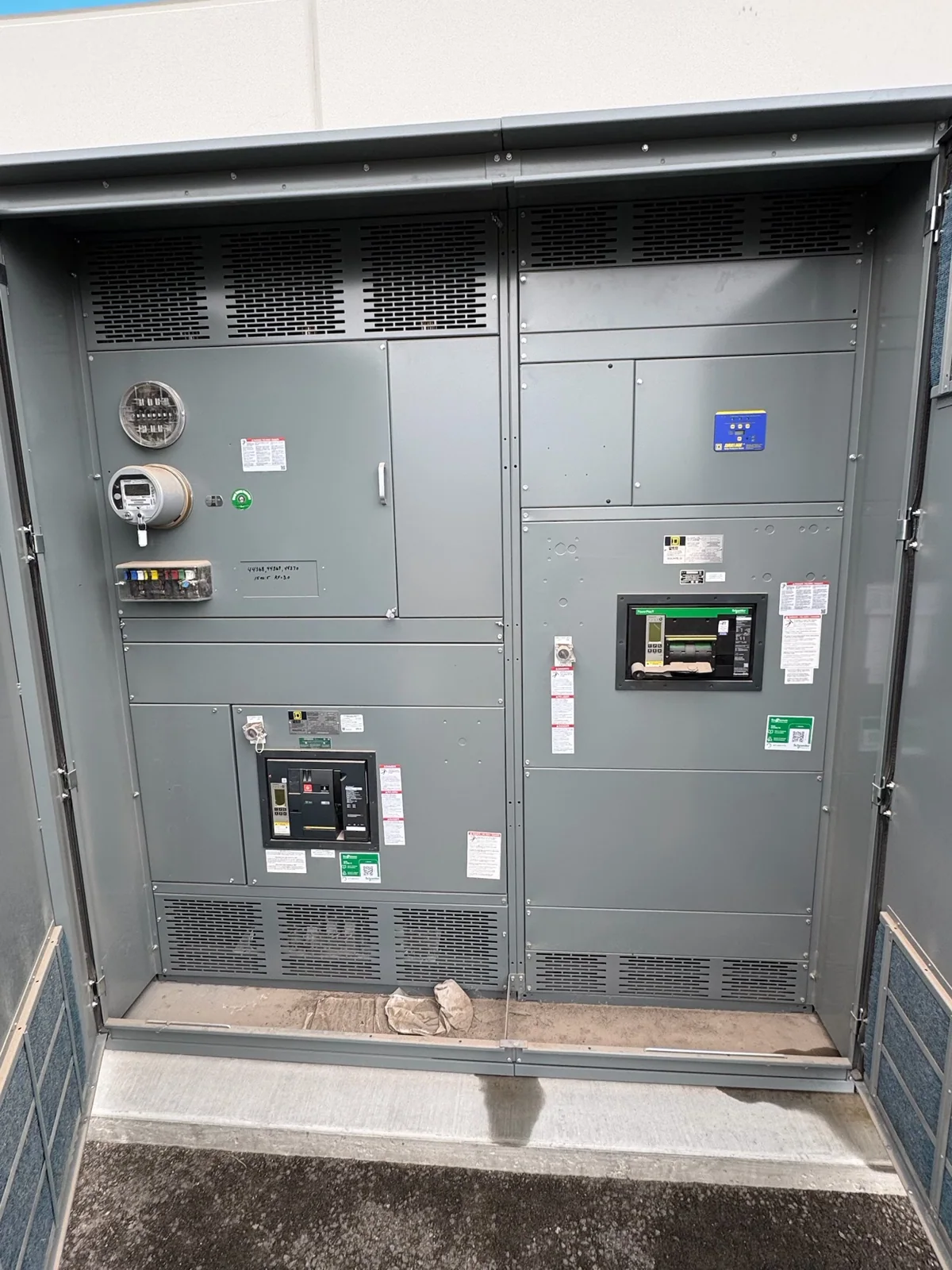
Selling pad-mounted switchgear in Canton, Ohio, starts with defining what is actually available. An outdoor enclosure beside a service may look like one item, yet ownership, electrical function, and the proposed replacement can divide it into different boundaries. An evaluation needs equipment identity, documented ratings, lot completeness, condition, and a safe path to release.
Two hypothetical Canton sale situations
Hypothetical situation one: a service replacement
Imagine an owner planning a service replacement at an operating property. The proposed sale may include one pad-mounted enclosure with three visible switching devices, but an adjacent transformer, metering equipment, protective control, or utility-owned section may remain. Identify the proposed switchgear by its enclosure label or existing record and separately list everything intended to stay. Do not treat proximity as proof of common ownership. A utility boundary, easement, lease, or service agreement may control release, and those facts are unknown until authorized parties confirm them.
Useful records could include a one-line drawing, equipment schedule, prior installation paperwork, and planned replacement scope. If a manufacturer name, series, serial number, voltage, continuous-current rating, interrupting or fault-duty marking, and switch arrangement are plainly visible from a safe exterior position, transcribe them. Do not infer a voltage class from enclosure size or appearance. A qualified, authorized team must establish safe conditions and handle disconnection; the seller does not need to open, operate, dismantle, or test anything.
Hypothetical situation two: an outdoor surplus lot
Now contrast that with a hypothetical surplus lot from a decommissioned data center or shut-down power plant. Several pad-mounted units might be stored outdoors, with loose nameplates, doors, barriers, fuses, operating handles, or spare devices nearby. The apparent quantity is not automatically the sale quantity. List each enclosure separately, then identify associated switches or other devices. Note whether accessories are installed, separately stored, unidentified, or missing. A spare that cannot be matched to a specific enclosure should remain unknown rather than being advertised as compatible.
This second situation also calls for honest environmental disclosure. Report known oil, fluid, chemical, fire, flood, corrosion, or other contamination concerns, along with staining or damaged coatings visible without disturbing the equipment. Unknown internal condition should be described as unknown. Safe exterior photos and existing records are appropriate; photos should never require anyone to enter a restricted area, remove a cover, or approach energized equipment.
Build a useful identification and lot record
For each proposed item, record the enclosure designation, manufacturer if visible, serial or asset number if documented, approximate dimensions, switch count, device type, and every legible rating. Include the owner’s location description without assuming a site label proves ownership. Distinguish the complete assembly from individual switches, fuses, elbows, controls, or accessories. If records conflict with a label, preserve both references and flag the discrepancy.
A concise inventory can be organized like this:
- One outdoor enclosure, documented manufacturer and model unknown, with visible voltage and current markings to be confirmed from records.
- Three installed switching devices, each listed by its visible label or marked unknown rather than assigned an unsupported rating.
- One separately stored accessory carton, contents and association unknown.
- Adjacent transformer and utility equipment excluded from the proposed lot unless ownership and release authority are confirmed.
That level of separation helps prevent a common mistake: valuing a cabinet as though every nearby component belongs to it. It also gives the buyer a defensible basis for evaluating all voltage classes instead of guessing from photographs.
Condition, value, and safe release
Offer considerations can include documented ratings, manufacturer and series, completeness, identifiable devices, enclosure integrity, corrosion, water intrusion evidence, damaged hinges or locks, and whether accessories can be matched. Stored equipment may be easier to evaluate when packaging and records are intact, while outdoor exposure may reduce confidence where labels are unreadable or contamination is reported. The absence of a test is not a problem for the seller: no seller testing is required. Evaluation must rely on supplied documentation, safe exterior information, and the buyer’s review process.
Value also depends on whether the buyer can receive a clearly defined lot. Ownership approval, release date, remaining service obligations, and any retained adjacent asset matter as much as a nameplate. Once an agreement is reached, payment is made upfront and the buyer coordinates the practical removal. The seller is not expected to provide a crane, qualified disconnects, rigging, loading, freight, or hauling. Access approvals, escort rules, outage coordination, and arrival windows should be coordinated with the authorized site contact rather than treated as removal work for the seller.
Questions to answer before evaluation
- Who owns the enclosure, installed devices, spare parts, and adjacent transformer or utility equipment?
- Which exact units are proposed for sale, and which assets must remain in service?
- What voltage, current, fault-duty, manufacturer, serial, and device information appears in existing records?
- Are contamination, fluid leakage, flood exposure, corrosion, impact, or missing components known?
- What authorized release date, access approval, escort requirement, and loading-area restriction applies?
- Can the owner provide drawings, schedules, asset records, and safe exterior photos without anyone touching the equipment?
For a Canton evaluation, a precise lot boundary is more useful than a confident assumption. Share what is documented, identify what is unknown, and separate customer-owned switchgear from utility-owned or retained assets. That approach supports a realistic cash offer while keeping electrical safety, ownership authority, and removal coordination in the right hands.