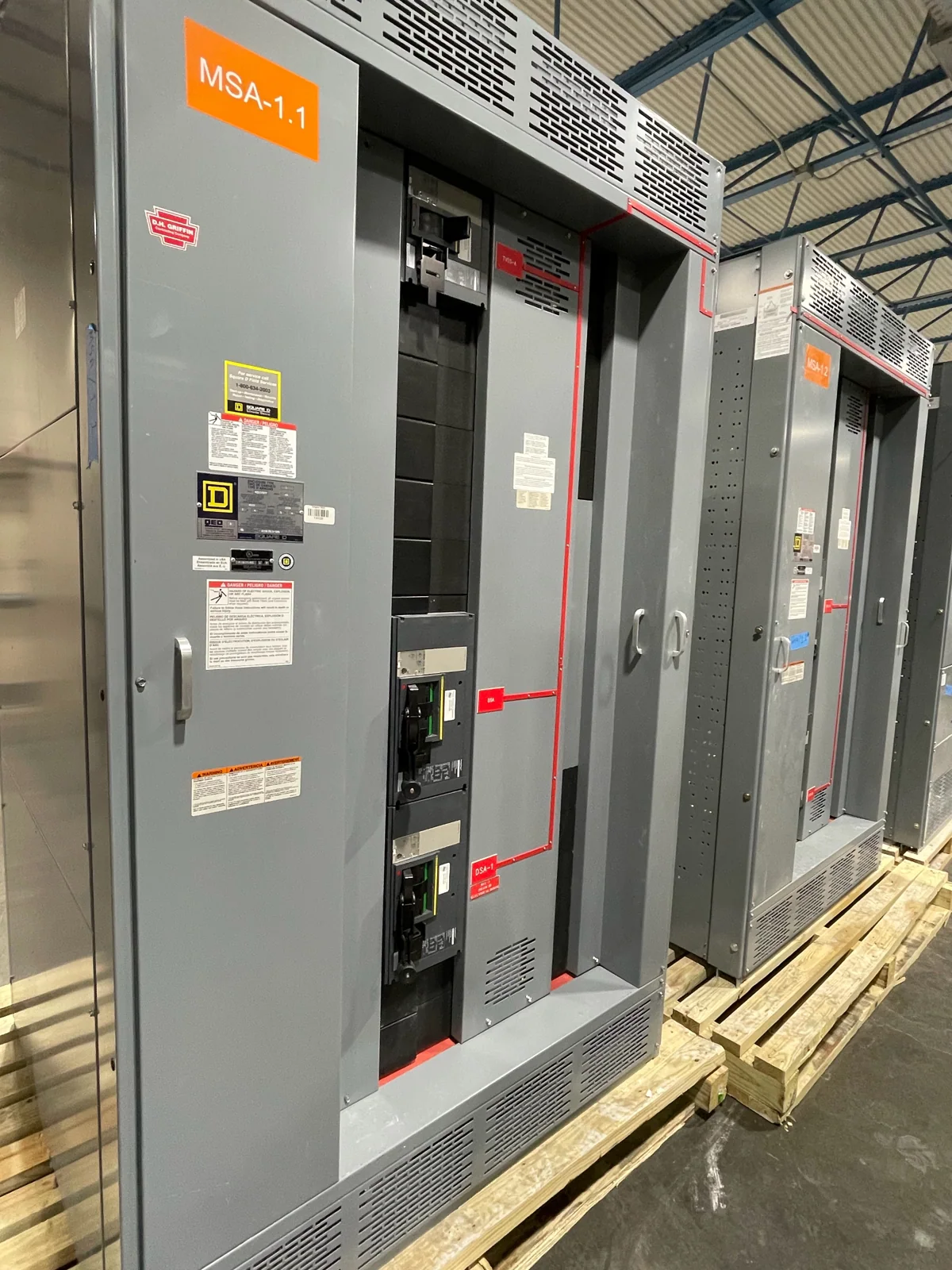
A realistic inventory question often starts with a room being cleared, not a perfect spreadsheet. Imagine a hypothetical customer-side service changeout in Stark County: a facilities manager has one medium-voltage lineup still installed, several removable breakers on pallets, and drawings of uncertain revision. The pickup site could be anywhere in the county rather than Canton. Before value is discussed, separate what is owned, what is released, and what is merely nearby.
Start with documented identity
Identify medium-voltage switchgear from records and visible exterior labels, never appearance alone. Gather the documented system voltage, continuous current, manufacturer, lineup or section count, and protective devices. Useful material may include nameplate transcriptions, one-line diagrams, equipment schedules, breaker lists, purchase files, and decommissioning notes. If a label is partly unreadable, call the missing portion unknown rather than guessing a voltage class or interrupting capability.
Record each section separately. A main incoming section, bus-tie, feeder, metering compartment, and spare or transition section can have different functions. Note the protective devices associated with each position only as documented. A breaker on a pallet is not automatically part of the installed lineup.
Define the lot and ownership boundary
For this hypothetical customer-side service replacement, establish where customer-owned equipment ends and utility-owned equipment begins. That boundary may appear in a contract, one-line drawing, service agreement, or asset register; do not infer it from location or enclosure style. List proposed sale sections, adjacent retained equipment, and any utility interface separately. Pending utility permissions, landlord approvals, environmental review, or outage coordination are release conditions to identify early. They are coordination items, not a request for the seller to pay removal costs.
A useful inventory might read: “four documented lineup sections, one incoming, two feeder, one bus-tie; three loose breakers tagged to feeder positions; two relay panels present; one control cabinet with association unknown.” Also state whether covers, shutters, truck assemblies, hardware, control wiring, and shipping braces are visibly present or missing. If equipment is split between an electrical room and storage area, identify each location and its access restrictions.
Describe condition safely
Condition reporting can rely on existing records and safe exterior photos. Exterior views may show nameplates, section doors, labels, corrosion, impact marks, water staining, contamination, missing covers, or packaging damage. Never require a seller to open a compartment, operate a mechanism, approach energized equipment, dismantle a device, or perform an electrical test. State whether the lineup is installed, isolated by an authorized party, stored indoors, or exposed to weather if known. A qualified, authorized team must establish safe conditions.
Condition and completeness are separate valuation questions. A clean enclosure with an undocumented missing breaker is not a complete lineup, while a stored breaker with clear identity may add value even when its matching section remains in service. Unknown insulation history, relay configuration, moisture exposure, prior fault involvement, or storage duration should remain unknown. Do not promise that components fit another lineup merely because cabinets look similar.
What can affect an offer
An evaluation may consider documented voltage and current, manufacturer, section configuration, protective-device identity, completeness, condition, ownership clarity, and safe-logistics complexity. A clearly documented device can matter, but an unverified rating does not become reliable because it appears on a separate breaker label. Equipment that must remain in service, belongs to the utility, or lacks release authority cannot be treated as available inventory.
The business buys electrical equipment across voltage classes and can consider medium-voltage switchgear from decommissioned data centers and shut-down power plants as well as other facilities. This does not confirm a particular Stark County project, brand, model, or buyer application. Supply manufacturer names and model numbers only when visible or documented. After reviewing the lot, the buyer can make a cash offer; once the seller accepts and the transaction terms are agreed, payment is made upfront before the agreed pickup, with the amount depending on supportable inventory rather than a generic county estimate. No seller testing is required.
Plan access, release, and freight
Share the facility contact, ownership authorization, access approvals, loading restrictions, available hours, floor or doorway constraints, and whether the site remains occupied. The actual pickup address may be elsewhere in Stark County, so do not assume Canton. Include safe exterior photos of the lineup, stored devices, staging area, and travel path when permitted. Coordinate approvals with the owner, utility, landlord, and site safety personnel as applicable.
After agreement and authorized release, the buyer handles qualified disconnects, crane coordination, rigging, loading, freight, and hauling. The seller does not arrange removal or perform energized work. Access approvals still need coordination so the qualified team arrives when the equipment is safely released and the route is clear. Section dimensions, recorded weights, door heights, dock availability, overhead obstructions, and turning space help plan the lift; do not dismantle or move equipment to obtain measurements.
Questions that make an inventory actionable
- Who owns each section, loose breaker, relay, and control cabinet, and who can authorize release?
- What documented voltage, current, manufacturer, section designation, and protective-device information is available?
- Which sections are included, which must remain, and which assets are utility-owned or excluded?
- Are stored devices tagged to positions, or are their associations unknown?
- What exterior condition, storage, contamination, impact, or missing-component facts are recorded?
- What access approvals, safe-release date, loading hours, doorway limits, and site contacts apply?
Send existing documentation and safe exterior photos for evaluation, leaving isolation, disconnection, rigging, loading, and hauling to qualified authorized personnel. Clear boundaries and honest unknowns let a Stark County seller present useful medium-voltage inventory without taking unnecessary electrical or removal risks.