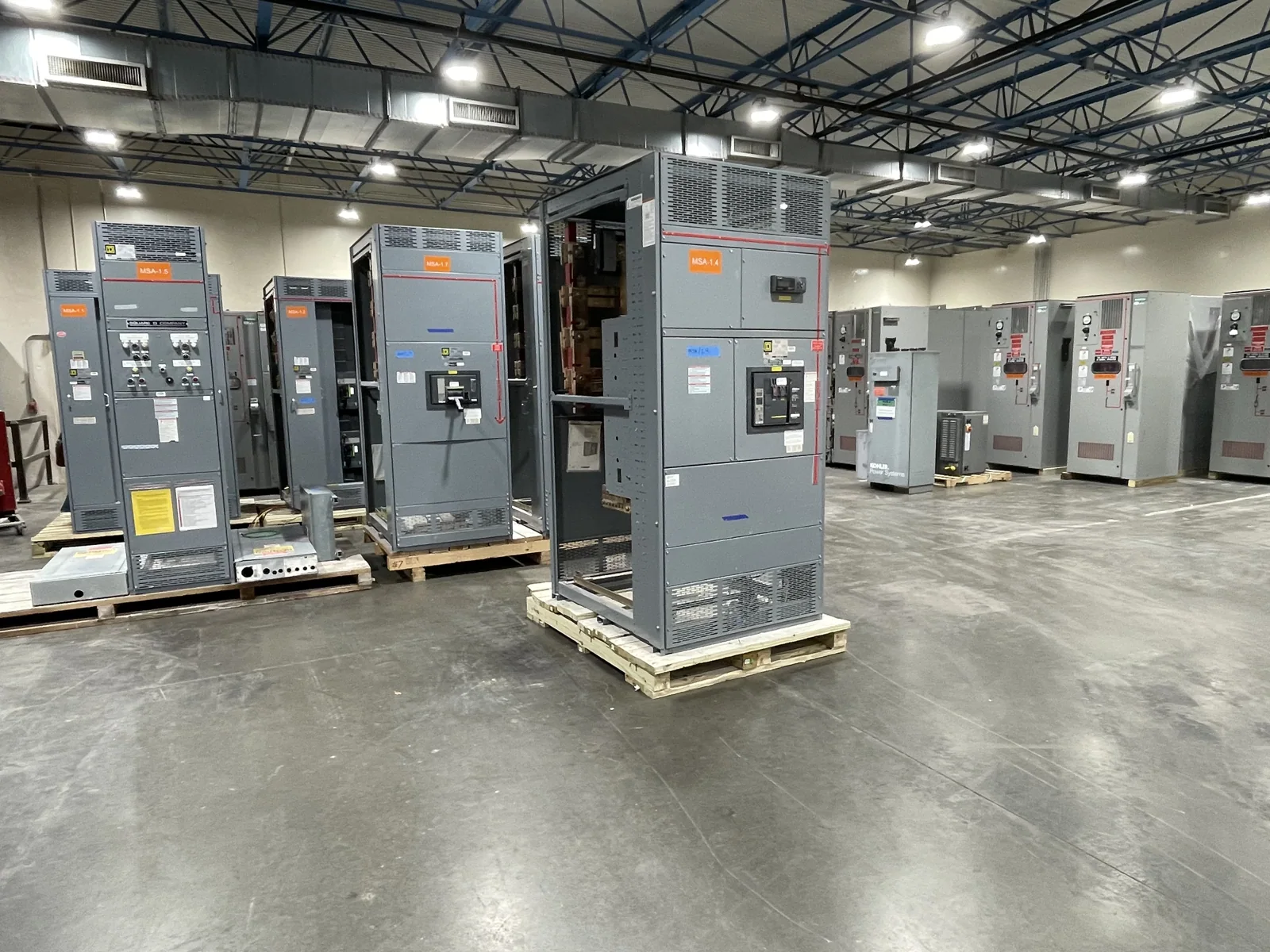
For a medium-voltage switchgear owner in Summit County, Ohio, the difficult part of a sale is often not finding a nameplate. It is proving which parts belong together, which equipment is released, and how a substantial lineup can leave the site without disrupting retained service. The buyer considers all voltage classes, including medium-voltage assemblies, but does not infer a voltage class from enclosure appearance. Documented facts are more useful than assumptions.
Build an equipment map before counting pieces
Start with available one-line diagrams, equipment schedules, lineup drawings, nameplate transcriptions, breaker schedules, maintenance files, and safe exterior photographs. Useful fields include manufacturer, documented voltage, continuous current, interrupting information where shown, section identifiers, bus arrangement, protective relays, fuses, instrument transformers, and section count.
Separate installed equipment from stored devices. Record each lineup section by its visible identifier, then list removable breakers beside the section or position associated with them in the records. A breaker on a pallet may be a spare, a device for another lineup, or an item with an unknown relationship. Do not combine those categories because housings look similar. The assembly’s documented voltage and current are not automatically the rating of every breaker, relay, or accessory within it.
Hypothetical plant-shutdown example
Hypothetical example: A shut-down industrial plant in Summit County has three indoor medium-voltage sections, two removable breakers still in documented cubicles, and four loose breakers in a maintenance room. The inventory should identify the three sections, the two installed devices, and each loose device separately. If the schedule links only two loose breakers to specific positions, the other two should be marked association unknown, not presented as a complete set. That distinction prevents an attractive-looking lot from being valued as a matched lineup when fit or control information is missing.
Completeness and condition
A practical inventory notes section count, doors and covers, breaker quantity, spare-device quantity, relays, fuses, hardware, control components, shipping braces, and tagged accessories. State what is absent as carefully as what is present. Missing covers, damaged doors, removed control wiring, corroded hardware, water staining, oil or chemical concerns, rodent damage, and long outdoor exposure can change the assessment of handling and downstream usability.
Safe exterior photographs can show labels, section faces, overall arrangement, storage packaging, and visible damage. The seller does not need to open compartments, operate mechanisms, dismantle anything, touch energized equipment, or test the gear. A qualified and authorized team must establish safe conditions and handle disconnection. A seller’s statement that equipment is “working” is not a substitute for documented identification, and no seller testing is required for an offer review.
Ownership, release, and approvals
In a plant shutdown, authority can be divided among the owner, landlord, lender, utility, environmental representative, and decommissioning contractor. Confirm that the proposed lot is customer-owned and identify any utility boundary or retained section. The buyer needs an authorized release contact, confirmation of the sale boundary, the earliest permitted release date, and rules for escort, security, badging, photographs, or work hours.
If a building contains both decommissioned gear and active distribution, identify the exact sections offered and the equipment that remains. A phased shutdown may create separate release dates; list those dates rather than describing the whole plant as immediately available. Share outage constraints and restricted travel paths early so a possible sale is not confused with permission to disturb live operations.
Plan removal around the real route
Medium-voltage lineups can be heavy, tall, and difficult to move through an electrical room. Useful logistics information includes doorway and corridor clearances, floor transitions, dock or ground-level access, turning space, overhead obstructions, elevator limits, staging area, and whether a section can exit in its existing configuration. Do not estimate shippable dimensions from a brochure or distant photograph; use available drawings or measured records without asking an unqualified person to approach equipment.
After agreement, the buyer handles the crane, qualified disconnects, rigging, loading, freight, and hauling. The seller helps coordinate access approvals, ownership paperwork, escorts, and the agreed release window. A shutdown may have a crane exclusion zone or demolition sequence controlling truck entry; disclose those constraints, but they do not transfer removal costs to the seller.
Information that supports a clearer offer
For a Summit County submission, provide documented voltage and current, manufacturer, section identifiers, protective-device list, breaker-to-section associations, storage locations, condition notes, ownership status, and release requirements. A spreadsheet is useful when it separates installed sections from stored devices and identifies every unknown. Include safe exterior photos only, available drawings, and the name of the person authorized to approve release.
Valuation can reflect completeness, documented identity, matching devices, specialist protective components, condition, sheltered storage, recoverable accessories, handling complexity, and freight effort. A partial lot may still be considered when its boundary is clear; an incomplete or uncertain lot may receive a different assessment. After reviewing the lot, the business can provide a cash offer; once the seller accepts and the sale is agreed, payment is made upfront before the agreed pickup, with no testing required from the seller.
Questions to answer before review
- What documented voltage, current, manufacturer, and section count appear in the records?
- Which removable breakers are installed, which are stored, and what records associate them with a lineup position?
- Which protective devices and accessories are included, and what is missing or unknown?
- Who owns the equipment and who can authorize release of each section?
- What approvals, release dates, clearances, staging limits, or active-service boundaries must be coordinated?