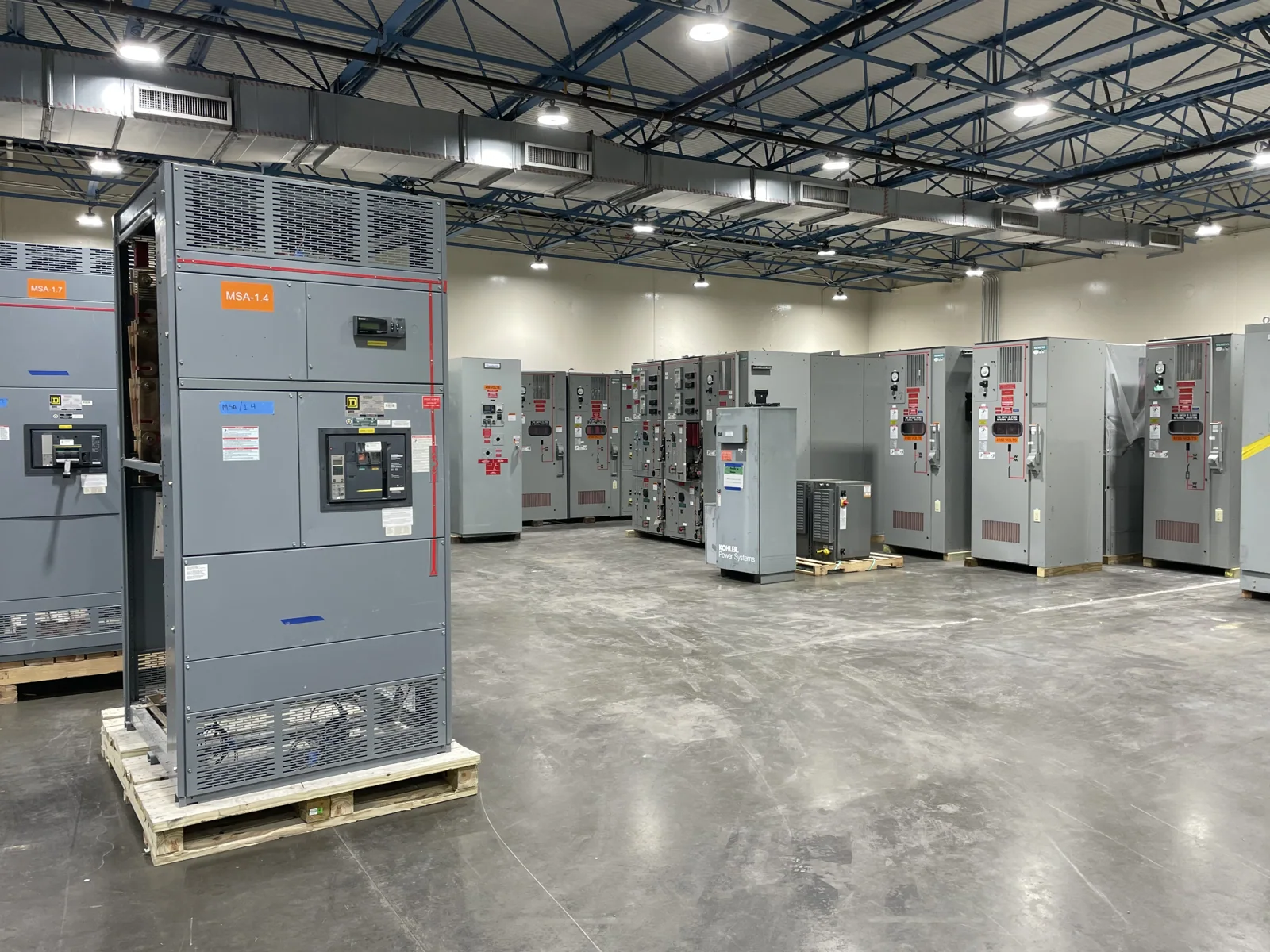
A hypothetical surplus inventory in Hancock County may begin with several motor control center sections standing in storage, while an old spreadsheet says more starter buckets exist than anyone can immediately see. Findlay is the county seat, yet the actual pickup site may be elsewhere in Hancock County. A useful evaluation starts with identifiable equipment, ownership authority, and records explaining what the stored lineup once served.
Build an inventory from sections and bucket tags
Begin with the vertical sections, not a single pooled count. Record each section’s exterior label, approximate dimensions, manufacturer wording, lineup designation and any visible assembly voltage or current information. Then count the starter buckets, feeder units, variable-frequency drives, soft starters and blank or reserved spaces within each section. A bucket tag, schedule reference or handwritten identifier can be more useful than a broad description such as “one MCC.” Do not infer a voltage class, horsepower range or compatibility from appearance alone; the documented nameplate and available drawings control what is known.
Bucket schedules should be compared with what is visibly present, while keeping uncertainty explicit. A schedule may list a motor starter that was removed years ago, or a bucket may be stored separately from the section to which it belongs. Shared control circuits deserve special attention: a control transformer, common terminals, network component or interlock may serve several buckets rather than traveling with one device. If that relationship is unclear, mark it unknown instead of assigning it to the lot by assumption.
Lot completeness and condition
For a stored lot, completeness includes more than the number of buckets. List covers, doors, handles, barriers, pull sections, wireway pieces, mounting hardware and loose control components. Missing covers can affect safe handling and valuation even when the bucket interiors appear intact. Note dented enclosures, bent hinges, corrosion, water staining, damaged labels, cut conductors and evidence of rough storage from the exterior only. Do not open compartments, operate handles or disturb equipment to improve the inventory. Safe conditions must be established by a qualified, authorized team.
Hypothetical example: a storage record might show three vertical sections and twelve starter buckets, while a visual count finds ten tagged buckets, one untagged bucket and two missing front covers. The right description is not “twelve complete starters.” It is three sections, ten matched tags, one unconfirmed bucket, two missing covers and an unresolved schedule difference. That precision lets the buyer evaluate what is actually available without turning an old record into a promise.
What influences an evaluation
Valuation can reflect documented voltage and current, section count, bucket type, device ratings, manufacturer and series, included drives or controls, and whether components remain associated with their original lineup. A complete, legible bucket schedule may reduce uncertainty; loose devices with no traceable section may be assessed differently. Condition, storage environment, missing hardware, visible damage and unknown components also matter. A seller should not represent a device as operational merely because it looks clean.
Ownership and release authority are equally important. Confirm whether the inventory belongs to the facility, a contractor, a landlord or another party, and identify the exact lot boundary. Existing records can include purchase documents, packing lists, drawings, maintenance notes and decommissioning records. Safe exterior photographs of nameplates, section labels, bucket fronts, damage and the storage arrangement are helpful. Photos should be taken only from a safe position, without opening equipment or touching electrical parts.
Coordinate access, removal and freight
After agreement, access is coordinated with the authorized site contact. Share the pickup location, release window, security or visitor requirements, loading-hour restrictions, floor or doorway limitations, and whether a dock or level entrance is available. County-wide records do not establish a particular address or building layout, so those facts remain unknown until the owner confirms them.
The buyer handles the crane or other lifting arrangement, qualified disconnects, rigging, loading, freight and hauling. The seller does not need to dismantle, test or prepare energized equipment. Coordination may require outage approvals, escort arrangements or a release signature, but those are access and ownership steps rather than a request for the seller to perform hazardous removal. A qualified, authorized team must establish safe conditions and handle disconnection. No one should open, operate, move or touch equipment that may be energized.
Example inventory and useful seller questions
- Section A: exterior label and documented assembly information, with five bucket tags and one reserved space.
- Section B: four tagged buckets, one missing cover, visible enclosure dent, and a control connection described in records but not verified.
- Section C: two buckets plus a separately stored drive whose section association is unknown.
- Loose items: schedule pages, spare covers, hardware and any devices whose ownership or lineup match still needs confirmation.
Before an evaluation, ask: Which party can authorize release? Is the inventory stored at one Hancock County site or several? Which bucket tags match the schedule? Are drives, controls and spare buckets included? Which covers or hardware are missing? Are any sections retained for another operation? What access approvals and release date apply? Existing records and safe exterior photos are enough to begin; seller testing is not required.
Once the lot boundary, documentation, condition and access plan are understood, the buyer can make a cash offer. After agreement, payment is made upfront, while the buyer coordinates qualified removal and transportation. Unknown facts can remain identified as unknown until the authorized site process resolves them.