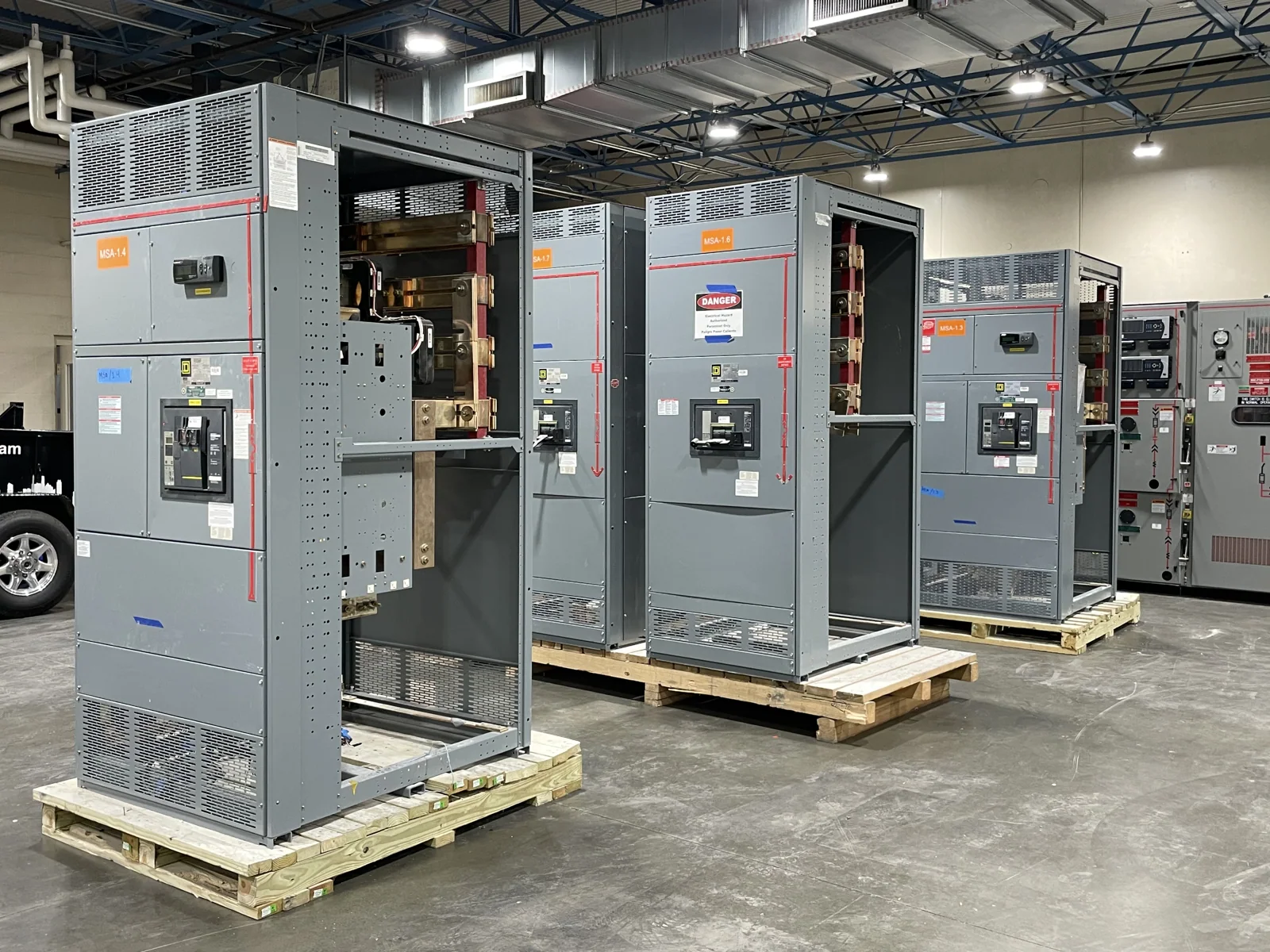
Start with a documented equipment identity
For a medium-voltage switchgear evaluation in Toledo and Lucas County, appearance is not enough to establish a voltage class. Start with documented voltage, continuous current, manufacturer, lineup or section identification, protective devices, and available drawings or schedules. A safe exterior photograph of a nameplate, label, cubicle face, or section tag can help, but do not open compartments or operate anything to obtain it. Existing records are valuable when labels are faded or inaccessible.
Record the lineup one section at a time. Note the incoming section, feeder sections, bus-tie or transition sections if documented, and the protective devices associated with each position. A breaker stored nearby is not automatically part of the installed assembly. Describe it as a stored device until a schedule, tag, or other reliable record connects it to a section. Do not infer that two devices fit because their housings look similar.
Define ownership before discussing release
A hypothetical Toledo service upgrade may leave an old customer-owned lineup beside a utility-owned boundary or equipment that must remain in place. That boundary affects what can be offered. Ask an authorized representative to identify the incoming point, customer-owned sections, retained equipment, and exact sale lot. The utility boundary is a coordination question, not an assumption based on which enclosure is closest to the service entrance.
Release approvals should be documented before removal planning. Useful records may include an asset disposition authorization, an approved outage or de-energization plan, a landlord or lender release when applicable, and the person authorized to grant access. Unknown ownership should remain unknown, not be treated as transferable. The buyer can coordinate with authorized parties, but the seller should not promise access to equipment still required for service.
Build a complete lot description
Completeness is more than a section count. List each included section, documented label, approximate dimensions when known, and protective device or compartment associated with it. Separately list removable breakers, relays, fuses, instrument transformers, control components, barriers, hardware, transition pieces, and shipping covers that are present or absent. If a component is in storage, identify its container or room and recorded association. If no association exists, say so.
- Installed example: three documented lineup sections, with one incoming section and two feeder sections, subject to confirmation by owner records.
- Stored example: two tagged removable devices and one untagged device; the untagged item should be treated as unmatched.
- Documentation example: a single-line drawing and section schedule, with revisions and missing pages noted.
These are hypothetical inventory examples, not claims about a Toledo facility. Pooled counts can misstate value, especially when a spare is undocumented.
Describe condition without testing
Share known storage history, indoor or outdoor exposure, water intrusion, corrosion, contamination, impact, missing covers, and whether the lineup was removed from service. Safe exterior photographs can show labels and visible condition. Do not energize, operate, dismantle, open, or test the equipment for the evaluation. No seller testing is required; a qualified and authorized team must establish safe conditions and handle any disconnection.
Condition notes should distinguish visible facts from assumptions. “Exterior paint is chipped on the lower door” is more useful than “fully operational.” Past operation does not establish present suitability. The buyer evaluates documented condition, completeness, ownership, and removal circumstances without asking the seller to interfere with energized equipment.
What can affect an offer
Valuation may reflect documented voltage and current, manufacturer and configuration, section count, protective-device match, age, completeness, storage, corrosion, contamination, and safe-removal complexity. It can also reflect whether the lot is a coherent assembly or a mixture of unmatched sections and devices. The business considers equipment across voltage classes when inventory and release authority can be established.
A clear lot boundary supports a more useful offer. After reviewing the lot, the buyer can provide a cash offer; once the seller accepts and the sale is agreed, payment is made upfront before the agreed pickup. The seller does not need to test the switchgear. Final terms depend on available information and confirmed release conditions, not an assumed brand, rating, compatibility, price, or timeline.
Plan access and freight around the real site
Large switchgear sections make site logistics part of the evaluation. Share the building contact, access approvals, loading hours, floor or doorway restrictions, overhead clearances, dock or yard conditions, and security or lift coordination requirements. If dimensions or weights are unknown, mark them unknown and provide drawings or manufacturer records if available. Do not dismantle a section to make it easier to ship.
The buyer handles the crane, qualified disconnects, rigging, loading, freight, and hauling. The seller helps coordinate authorized access, release paperwork, and site rules; removal costs are not shifted to the seller. A qualified team establishes safe conditions and determines sequence. For the hypothetical upgrade, separate equipment that remains in service from the proposed lot and coordinate the approved outage and utility boundary before discussing a pickup window.
Questions to include with a Toledo inquiry
- What documented voltage, current, manufacturer, section labels, and protective devices are available?
- Which sections are installed, which devices are stored, and what records match each device to a position?
- Who owns the incoming equipment and who can authorize release at the utility boundary?
- What visible damage, moisture, corrosion, contamination, or missing components are known?
- What access approvals, dimensions, clearances, loading constraints, and release conditions must be coordinated?
Send existing records and safe exterior photos when available. Identify what is documented, physically present, and still unknown.