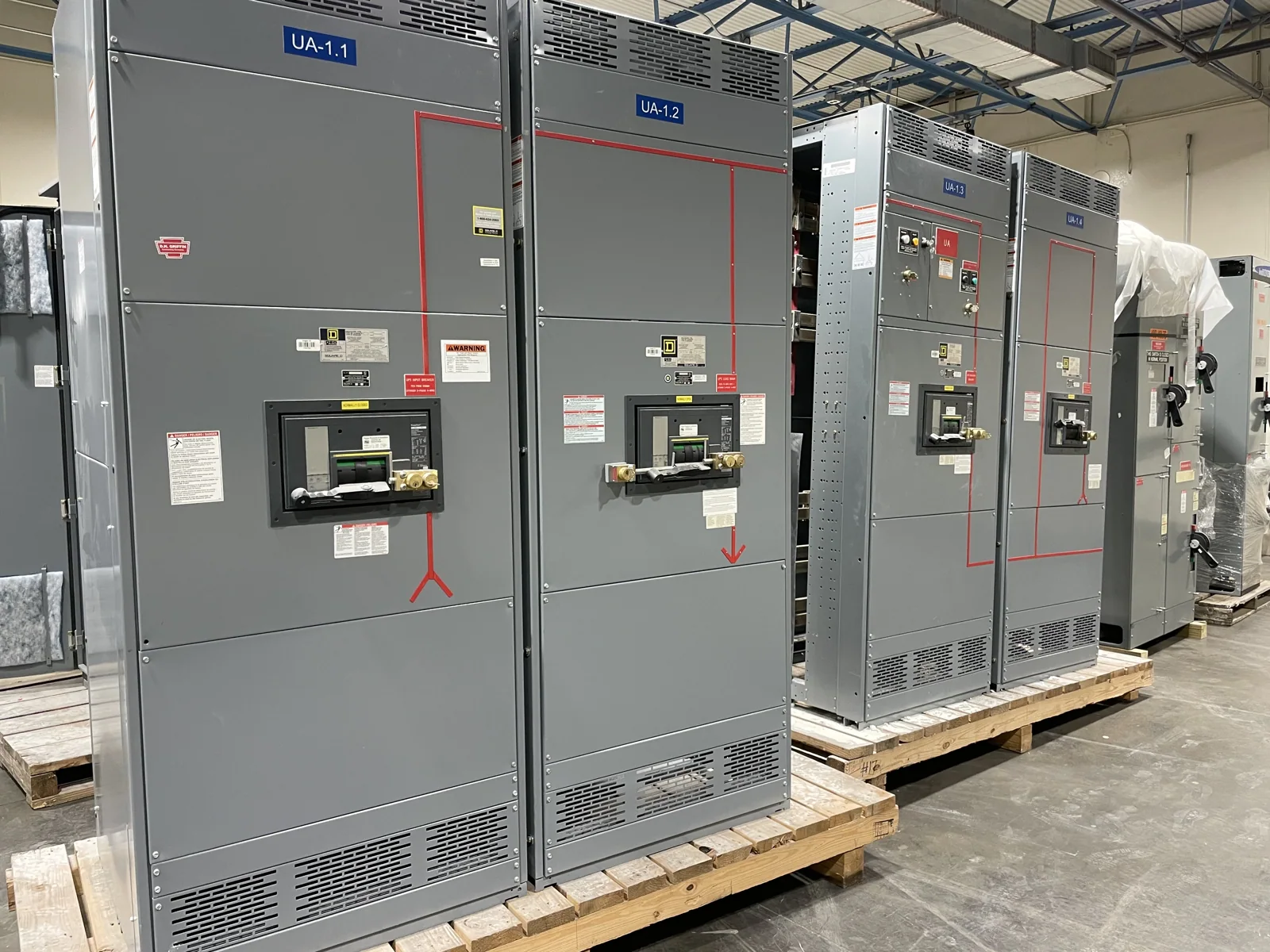
1. Identify the offered equipment
For a medium-voltage switchgear evaluation in Dayton, begin with records rather than appearance. Share one-line diagrams, equipment schedules, purchase files, and safe exterior photographs of closed nameplates when available. These can establish documented voltage, continuous current, manufacturer, lineup designation, section count, and protective devices. An enclosure’s color or a familiar breaker shape cannot prove voltage class, construction, or compatibility. Never open compartments, remove covers, operate handles, or approach equipment that may be energized. A qualified, authorized team must establish safe conditions and handle disconnection.
Record the lineup label exactly as shown. For each section, identify its documented main or feeder function, device, relay, fuse, transformer, or grounding equipment. Ask which sections are seller-owned and which remain part of the facility’s service. If a label or rating cannot be verified, mark it unknown instead of guessing.
2. Set the lot boundary and completeness
State whether the proposed lot is a complete indoor lineup, selected sections, or equipment already separated. Count installed sections individually and distinguish them from stored breakers, relays, CTs, fuses, control-power components, spare cubicles, and loose hardware. A stored device belongs with the lineup only when a tag, schedule, drawing, or other record supports that association; matching paint is not proof.
List every included section’s room or aisle, and identify retained sections, connected feeders, and adjacent gear outside the sale. A useful hypothetical inventory could read: one documented main section, four feeder sections, two removable breakers tagged to positions three and four, and one unverified spare in a separate cabinet. That is more decision-ready than “one lineup.” This example is hypothetical and does not describe a local installation.
3. Report condition without testing
Keep condition statements observational. Provide service and storage history, de-energization records, and maintenance notes when known. Safe exterior photos may show nameplates, doors, labels, corrosion, impact marks, missing hardware, or packaging. No seller testing is required: do not test insulation, rack a breaker, open a compartment, or energize anything.
Separate facts from uncertainty. “Exterior door has visible oxidation” does not establish internal bus damage. Mention documented moisture, contamination, fire effects, vermin evidence, or environmental restrictions. A clean exterior does not prove operating condition.
4. Understand valuation factors
An offer may reflect documented voltage and current, manufacturer, age, configuration, protective-device identity, completeness, condition, and useful spares. It may also reflect whether the lineup is intact, records match the physical inventory, and sections can be handled and shipped separately. Missing ratings, unidentified devices, corrosion, fluid concerns, or incomplete controls can reduce certainty and affect valuation.
All voltage classes can be considered, but written documentation controls. Do not substitute a breaker marking for the assembly rating or infer interrupting capability from visual similarity. Hypothetically, if drawings identify a medium-voltage main and three feeder sections while the room contains only two documented feeder breakers, report the missing position and status plainly. The scenario is hypothetical.
5. Plan the indoor access route
Indoor access can determine whether a Dayton lineup is practically releasable. Share room entrances, corridor turns, door clearances, floor changes, overhead limits, loading-door dimensions, and staging restrictions. Note maximum shippable section dimensions and weight when documented or safely confirmed by the qualified removal team; do not dismantle equipment to obtain measurements. Unknown dimensions should remain unknown.
Identify the expected outage window and the person authorized to coordinate it. An outage window is not permission to disconnect, and a site contact may not be the owner. The buyer coordinates with authorized representatives and facility safety and access requirements. The seller does not arrange the crane, qualified disconnects, rigging, loading, freight, or hauling; the buyer handles those activities. Access approvals still require coordination.
6. Send a decision-ready package
Include ownership confirmation, target release date, outage constraints, lineup and section list, drawings, nameplate transcriptions, breaker or relay schedules, service history, known damage, and safe exterior photographs. State what is included, what is retained, and what remains unknown.
- Documented voltage, current, manufacturer, lineup identifier, and section count.
- Installed versus stored protective devices, with tags or position references.
- Condition observations, storage history, missing parts, and environmental notes.
- Indoor restrictions, shippable dimensions if documented, and outage window.
- Owner, authorized release contact, records, and desired decision date.
7. Agree on safe release
Once the lot and boundary are understood, the parties can discuss release conditions, payment, and schedule. After reviewing the lot, the buyer can provide a cash offer; once the seller accepts and the sale is agreed, payment is made upfront before the agreed pickup. The seller must not operate, dismantle, disconnect, test, or touch energized equipment. Qualified personnel establish safe conditions and perform qualified disconnect work. The buyer handles crane coordination, rigging, loading, freight, and hauling; the seller coordinates building access and approvals available only to the site owner or operator.
Before release, confirm that agreed sections are available, retained equipment is excluded, and authorized-access records or keys are identified. If the outage changes, a section cannot pass through the route, or ownership is unresolved, pause and document the issue instead of improvising.
Questions before requesting an evaluation
- What voltage and current do the assembly records and device labels document?
- Which sections and protective devices are installed, stored, included, or retained?
- What condition and service or storage records are available?
- What route restrictions and maximum shippable section dimensions are known?
- Who can approve access, and what outage window is expected?
Those answers move a Dayton seller from identification to a clear lot boundary, a defensible valuation discussion, and a coordinated release without unsafe assumptions.