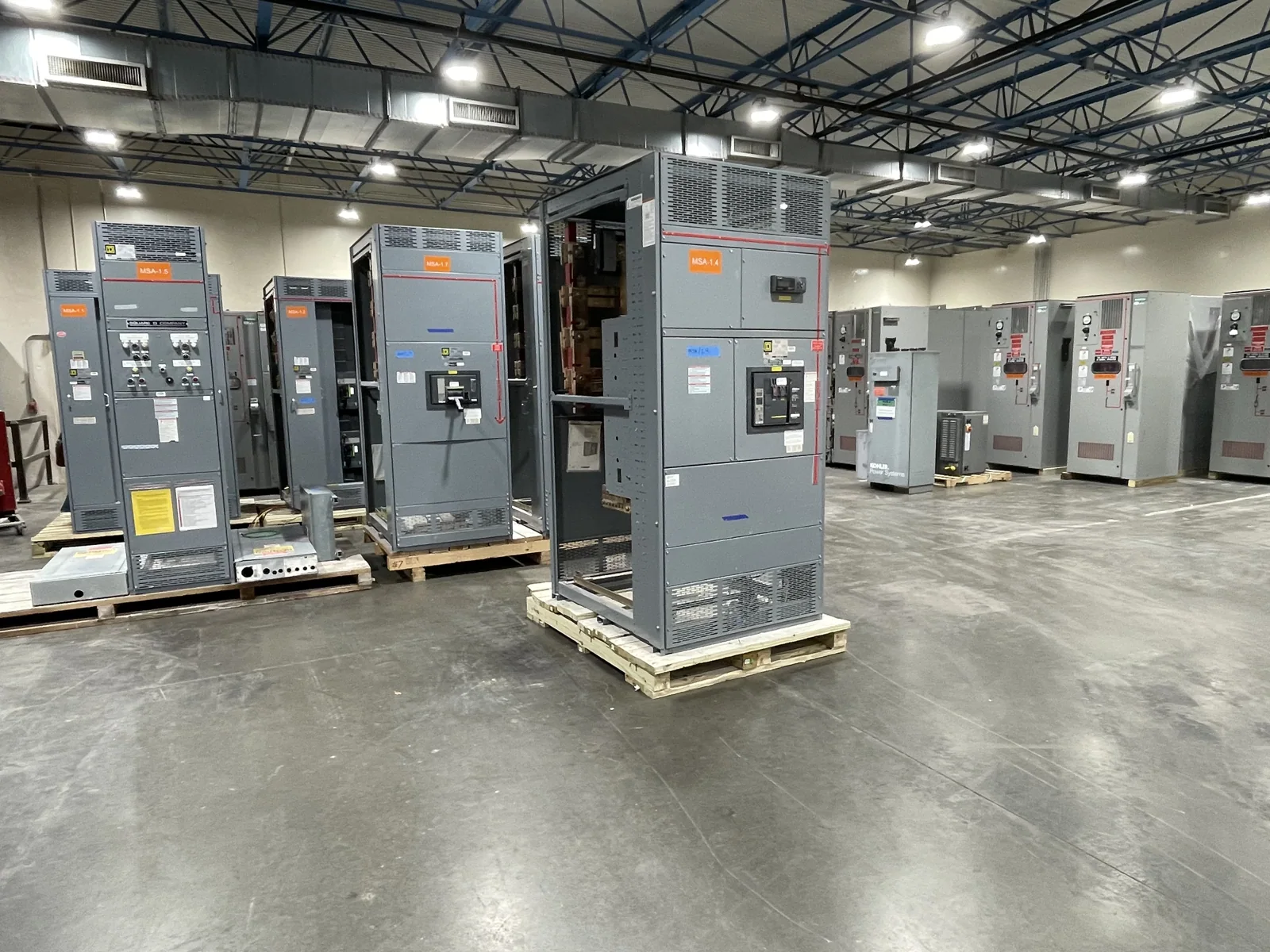
Medium-voltage switchgear in Ohio often has two stories: what the records say and what can actually be released. A useful evaluation reconciles them without asking a seller to open, operate, dismantle or test anything. Whether equipment came from a decommissioned data center, shut-down power plant or industrial facility, the buyer considers all voltage classes. Documented voltage, ownership and release boundary determine what can be reviewed.
Start with the documents that identify the lineup
Send existing one-line diagrams, equipment schedules, nameplate transcriptions, purchase records, maintenance files or decommissioning lists when available. A document can identify the manufacturer, lineup designation, section count, bus arrangement, breaker positions and protective devices more reliably than appearance. Record relays, fuses, instrument transformers, control power components and trip units only when documents establish them.
Use the full voltage wording shown on the assembly or nameplate, along with current and other stated ratings. Do not infer a voltage class from cabinet height, color, insulation style or brand. An assembly rating describes the lineup or section arrangement; a removable breaker has its own voltage, current and interrupting ratings. Those values are not interchangeable. A breaker stored beside a lineup is not automatically a match.
Build an inventory that separates installed and stored equipment
A practical inventory should identify each lineup, not merely report “one switchgear set.” For example, a hypothetical record might list Lineup A: four documented sections; manufacturer and actual voltage wording recorded from paperwork; three installed breakers; one protective relay panel; two separately stored breakers with association unknown; and one crate of control components with contents unverified. This is a reporting format, not a claim about an Ohio site.
- List each section or cubicle number and its documented function, such as incoming, tie, feeder or metering, when known.
- Count installed breakers separately from loose or stored breakers, and identify the source section for each device if records establish it.
- Record protective relays, fuses, CTs, PTs, control cabinets and visible accessories as included, excluded or unknown.
- Note drawings, manuals, test reports and spare-part tags that are actually present; do not treat missing paperwork as proof that a component is absent.
This prevents a common access problem: a complete-looking lineup may be in one room while breakers, relay panels or shipping hardware are elsewhere under different ownership or release dates.
Completeness and condition need separate answers
Completeness asks whether the proposed lot contains the sections and devices represented by documentation. Condition asks what can be observed without disturbing equipment. Safe exterior photographs may show nameplates, labels, doors, covers, corrosion, impact marks, water staining, packaging and storage conditions. Existing documents may disclose service history or known defects, but cannot establish present operating condition.
Describe unknowns plainly: interior condition unknown, breaker-to-section association unknown, protective-device settings unknown, or ownership of an adjacent section unresolved. Do not energize, operate, open compartments or perform testing for an evaluation. Qualified, authorized personnel must establish safe conditions and handle electrical and physical work. A photo of a closed enclosure and a copy of an existing record are the appropriate starting materials.
Ownership, boundaries and staged release
Before discussing a lot, confirm who has authority to release it. Medium-voltage equipment may sit in a leased building, utility interface area, contractor’s storage space or closing facility. The owner, landlord, utility, insurer or another stakeholder may control different sections. Ask for the documented boundary between customer-owned equipment and anything retained by another party. If unresolved, mark it unknown rather than assuming the entire room is available.
Staged release can change the inventory. A hypothetical shutdown may make feeder sections available first while an incoming section remains required until a later approved date. List each stage, its sections, stored devices and authorized release contact. Access approvals are coordinated with the seller and site representatives, not a request for the seller to fund or perform removal. An agreed window should identify areas that remain in service.
Offer considerations and physical access
Evaluation may consider documented ratings, manufacturer, section count, breaker population, protective equipment, completeness, age information, visible condition, storage environment and ownership clarity. It may also consider whether loose devices trace to the lineup, whether drawings travel with the lot and whether missing covers or controls change the scope. None guarantees a purchase, fixed price, compatibility or a test result.
Describe the path from room to loading point: door widths, floor transitions, stairs, overhead clearance, restricted hours, escorts, elevators, outdoor surfaces and any crane requirement. Do not estimate a shippable section dimension from a photograph. The buyer handles qualified disconnects, rigging, crane coordination, loading, freight and hauling. The seller identifies contacts, shares access rules and coordinates approvals; the seller does not dismantle, lift, test or transport equipment.
Questions to answer before release
- What manufacturer, actual voltage wording, current rating and lineup designation appear in existing records?
- How many sections are documented, and which breakers and protective devices are installed in each?
- Which breakers, relays, fuses, controls and manuals are stored separately, and which associations remain unknown?
- Who owns each section, and is any utility, landlord, tenant or insurer approval required?
- What is the approved release date or staged schedule, and which equipment must remain in service?
- What exterior access restrictions, escorts, loading rules or crane requirements should be planned?
After agreement, payment is made upfront under agreed terms, and the buyer coordinates qualified work and logistics. Begin with accurate documents, safe exterior views and unknowns for an informed evaluation.