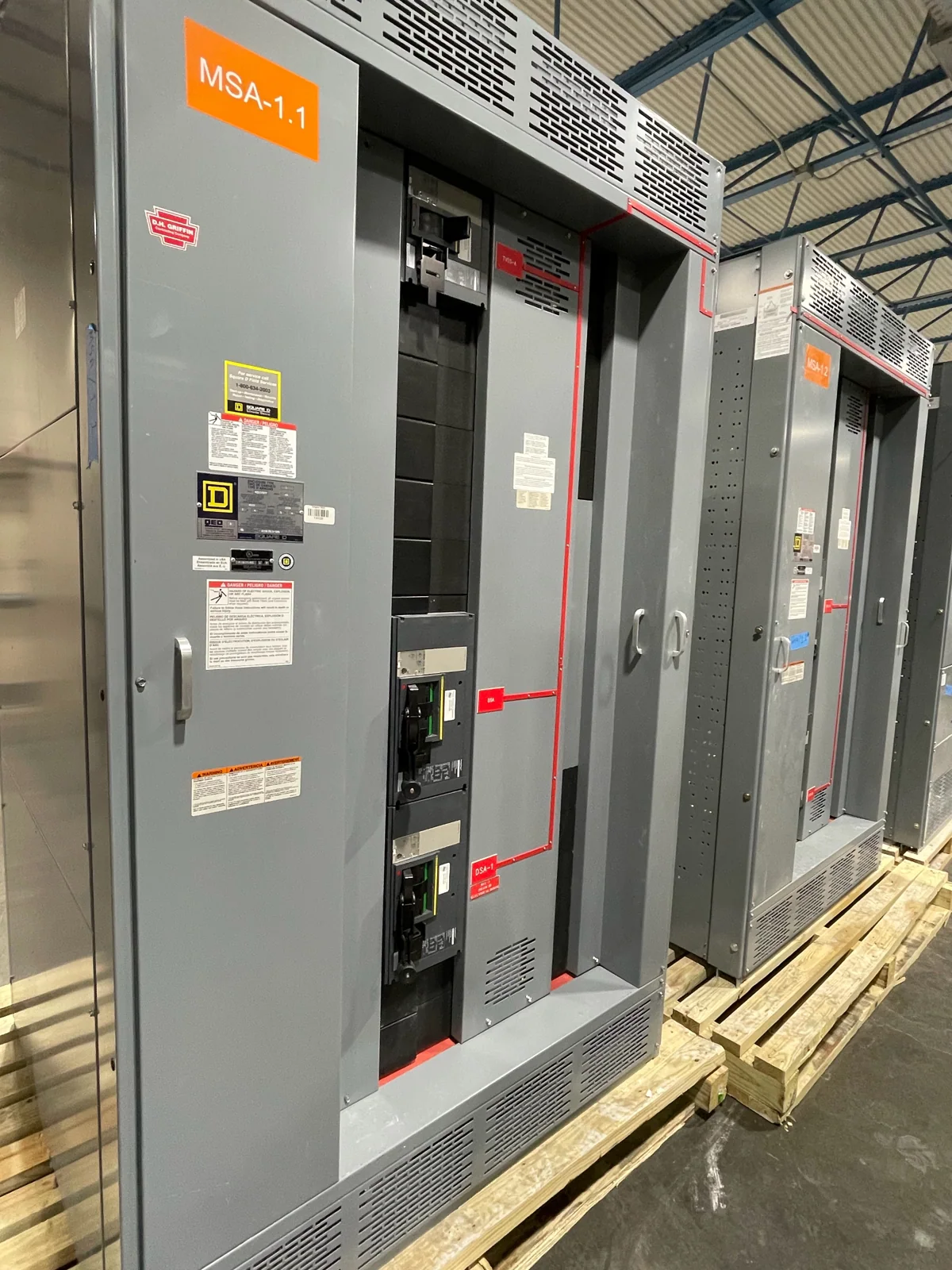
Sell Unit Substations from Industrial Closures in Ohio
Industrial decommissioning can release a unit substation as a coordinated lot rather than unrelated scrap. Start by defining what is offered: transformer, primary switchgear, secondary switchgear, bus duct, terminations, accessories, or a combination. The buyer considers all voltage classes; documented nameplates, completeness, condition, ownership, and a practical release plan matter more than a description such as “old plant transformer.”
Two hypothetical sale situations
Hypothetical situation one: a complete process-line substation
Imagine a closed manufacturing building with one unit substation serving a former process line. The proposed lot includes a transformer, primary fused switch, secondary main section, feeder sections, a short busway connection, and loose operating hardware stored in a labeled cabinet. The owner has a one-line drawing, transformer nameplate, section numbers, and photographs taken from safe exterior positions. This is a stronger starting point because the boundary is stated and the stored pieces can be compared with the installed lineup. The drawing may still contain sensitive production or security information, so the owner should remove those details before sharing it.
The evaluation would ask whether the transformer and switchgear remain together, whether a feeder is retained elsewhere, and whether loose hardware belongs to this assembly. Identify missing barriers, control wires, or termination kits rather than guessing. “Complete” means documented and accounted for, not merely intact-looking.
Hypothetical situation two: a partial shutdown with mixed ownership
Now consider a different hypothetical: a tenant vacates part of an industrial site, while the property owner keeps the incoming service and one active distribution path. A transformer appears to be available, but the adjacent primary section may be utility-owned, and the secondary lineup may include sections still serving another tenant. The sale boundary must be written section by section. A tenant’s equipment, a landlord’s fixed service equipment, and utility assets cannot be treated as one lot without authorization.
This lot may still merit review if available components are clearly identified. State exclusions, the release authority, and the shutdown milestone. Unknown ownership, voltage, and fluid status should remain unknown until records resolve them.
Build a useful inventory before the review
Use existing records and safe exterior photographs only. Do not open compartments, operate switches, touch energized equipment, dismantle anything, or perform seller-operated tests. A practical inventory can include:
- Transformer: manufacturer as shown, serial or asset number, documented primary and secondary voltage, kVA where legible, impedance if recorded, cooling designation if recorded, and whether fluid concerns are known.
- Primary side: switch or breaker description, visible nameplate data, section count, and the boundary between customer-owned and utility-owned equipment.
- Secondary side: main and feeder sections, bus or busway connection, feeder labels, neutral or grounding equipment where documented, and any retained section.
- Loose components: removable devices, fuses, relays, covers, transition pieces, hardware, manuals, and tagged spares, each matched to a section only when records support the match.
- Condition: exterior corrosion, dents, missing doors or covers, water intrusion, storage exposure, contamination, leaks, and any known environmental issue. Disclose known concerns; do not sample or investigate them yourself.
Records, condition, and value factors
Nameplates and one-line diagrams separate transformer ratings from primary and secondary device ratings. Include full documented voltage wording rather than inferring from appearance. Redact sensitive operational or security information before sharing drawings. Useful records include an equipment schedule, decommissioning scope, ownership statement, maintenance records, fluid information, and missing-parts list.
Offer considerations include section count and size, documented ratings, manufacturer and age when known, completeness, exposure, corrosion, fluid concerns, storage, and whether the equipment can release as one lot. For a heavy multi-section load, share dimensions and weights where available. These factors support a cash offer; seller testing is not required. After agreement, payment is made upfront under the agreed terms.
Plan access and release safely
Milestones should identify the closure decision, ownership approval, safe release date, access escort, and building or utility coordination. Qualified, authorized personnel establish safe conditions and handle disconnection. The seller is not asked to disconnect, lift, rig, load, or haul. The buyer coordinates qualified disconnects, crane service, rigging, loading, freight, and hauling; site parties coordinate access approvals and scheduling.
For a heavy multi-section load, share known doorway clearances, floor changes, overhead obstructions, turning restrictions, dock information, and staging limits from records or authorized site knowledge. Do not remove panels for dimensions. If weights, shipping splits, or travel paths are unknown, say so; coordinated planning can resolve them without shifting removal work to the seller.
Questions to include with the submission
- What exact transformer, primary sections, secondary sections, bus connections, and loose components are included?
- What are the documented primary and secondary voltages, and which nameplates or drawings support them?
- Who owns each section, and who has authority to approve release?
- Which parts remain in service, and what milestone makes the offered lot available?
- Are there known leaks, contamination, fluid concerns, water damage, corrosion, or missing covers?
- What records, redacted drawings, safe exterior photos, dimensions, and access notes are available?
Clear boundaries make an Ohio industrial closure reviewable without unsafe seller activity or unsupported assumptions. Share what is documented, identify unknowns, and let the buyer coordinate qualified removal and transportation after agreement.