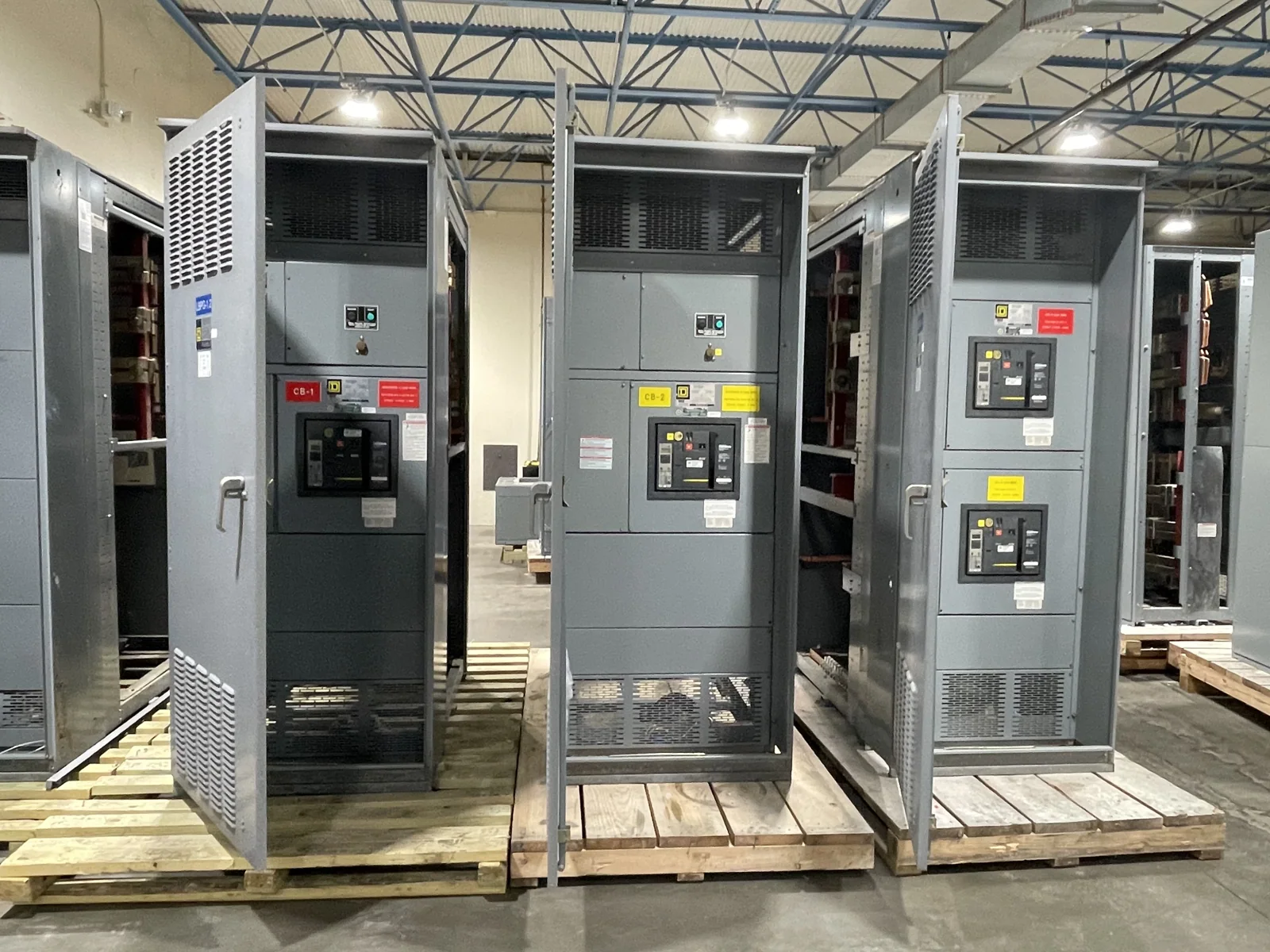
Start with the decommissioning inventory, not a guess
Imagine a hypothetical Ohio manufacturing campus closing one process building while a neighboring building remains in service. The owner has a lineup in each electrical room, loose breakers on pallets, and cabinets marked for retention. A useful buyer inquiry separates those facts instead of calling everything “the old switchgear.” Record each lineup by building, room, documented section count, and visible identification. Note which main, feeder, tie, or distribution sections are proposed for release. Context such as county, city, or shutdown reason does not establish what is included or who may release it.
This method also fits a hypothetical data center decommissioning, shut-down power plant, or industrial expansion that makes an older lineup surplus. The business evaluates all voltage classes, so report the voltage written on an assembly or device nameplate rather than classifying gear by appearance or cabinet size. If a value is unreadable or unknown, say so plainly.
Define the lot and its retained boundary
Match sections, breakers, and spares
List the lineup as identifiable sections rather than one unverified quantity. For each section, capture its label, documented function, approximate dimensions if already recorded, and associated breaker or protective device. Separately list removable breakers, control components, relays, shutters, hardware, and stored spares. A loose breaker belongs with the lot only when records or clear labeling support that association; a similar-looking device is not proof of compatibility.
Include available one-lines, equipment schedules, nameplate transcriptions, prior removal records, and safe exterior photographs. Before sharing drawings or photos, the owner should remove sensitive operational details, access codes, security layouts, and other unnecessary information. Do not open compartments or operate devices to improve the record.
Separate surplus from service that stays
Industrial shutdowns can leave unclear boundaries. A property owner may retain a service entrance, utility interface, emergency source, or feeder serving another tenant. A tenant may own interior distribution while the landlord owns the service lineup. In a hypothetical multi-building sale, identify the legal owner, tenant or operator, building contact, and exact section boundary proposed for release. Equipment serving an occupied area remains retained unless the authorized owner confirms otherwise.
Condition, environment, and offer factors
Describe condition using observable records, not optimistic assumptions. Note whether sections were installed, stored indoors, wrapped, exposed to moisture, moved previously, or affected by impact, corrosion, heat, dust, or contamination. Report missing doors, covers, hardware, labels, insulating barriers, or protective devices when known. A decommissioned process area may have unusual environmental history; disclose known oil, chemical, water, asbestos-related, or other concerns rather than sampling, disturbing, or making a clearance claim. Unknown conditions should remain unknown.
Value can reflect documented voltage and current ratings, manufacturer and series, section count, breaker identity, completeness, condition, storage, and handling cost. It can also reflect whether the equipment can be released as a coherent assembly or only as separately documented sections and devices. No single nameplate number determines an offer. Clear ownership, a realistic release milestone, and an accurate lot boundary reduce uncertainty; missing records or disputed components can do the opposite.
Plan milestones and physical access early
Provide the sequence already known: production end, owner approval, utility or tenant coordination, qualified disconnection, room release, and the date when equipment can be loaded. The buyer coordinates access approvals with authorized site contacts. The seller does not need to remove, test, dismantle, rig, or haul the equipment. After agreement, the buyer handles qualified disconnects, crane or other lifting arrangements, rigging, loading, freight, and hauling as applicable to the agreed lot.
Access details still matter. Identify doors, corridors, stairs, dock conditions, floor or overhead constraints, security check-in, escort requirements, loading hours, and whether a crane setup needs separate approval. Record dimensions and weights only from existing documentation or safe records; do not ask anyone to measure energized equipment or enter restricted areas. For an indoor lineup, note the path from its room to the loading point. Keep multiple buildings and release dates distinct rather than pooling inventory.
A practical hypothetical inventory example
- Building A: one documented lineup with eight sections; main and feeder labels are visible, while two breaker associations remain unknown.
- Building B: four sections proposed for release and two retained for another tenant; the owner identifies the boundary rather than a photo.
- Stored items: three labeled removable breakers, one control-component cabinet, and hardware with uncertain association listed separately.
- Records: a redacted one-line, exterior-position nameplate photos, equipment schedule, storage history, and proposed qualified-disconnection milestone.
This example is hypothetical. It shows useful specificity without asserting that these buildings, equipment, or shutdown exist in a particular Ohio location.
Questions to answer before an evaluation
- Who owns each lineup, stored device, and building service boundary, and who can authorize release?
- Which building, room, section numbers, breakers, and spares are included, and which equipment must remain?
- What voltage, current, manufacturer, series, and protective-device information is documented, unreadable, or unknown?
- What condition, storage history, damage, contamination, or environmental issue is already known?
- What shutdown, access-approval, qualified-disconnection, room-release, and loading milestones are anticipated?
- What doors, docks, escorts, lifting restrictions, and freight constraints should be coordinated?
Send existing records and safe exterior photos only. A qualified, authorized team must establish safe conditions and handle disconnection; no seller-operated test, energized access, opening, or dismantling is requested. Once ownership, scope, condition, and release logistics are clear, the buyer can evaluate the decommissioned switchgear as an actual lot.