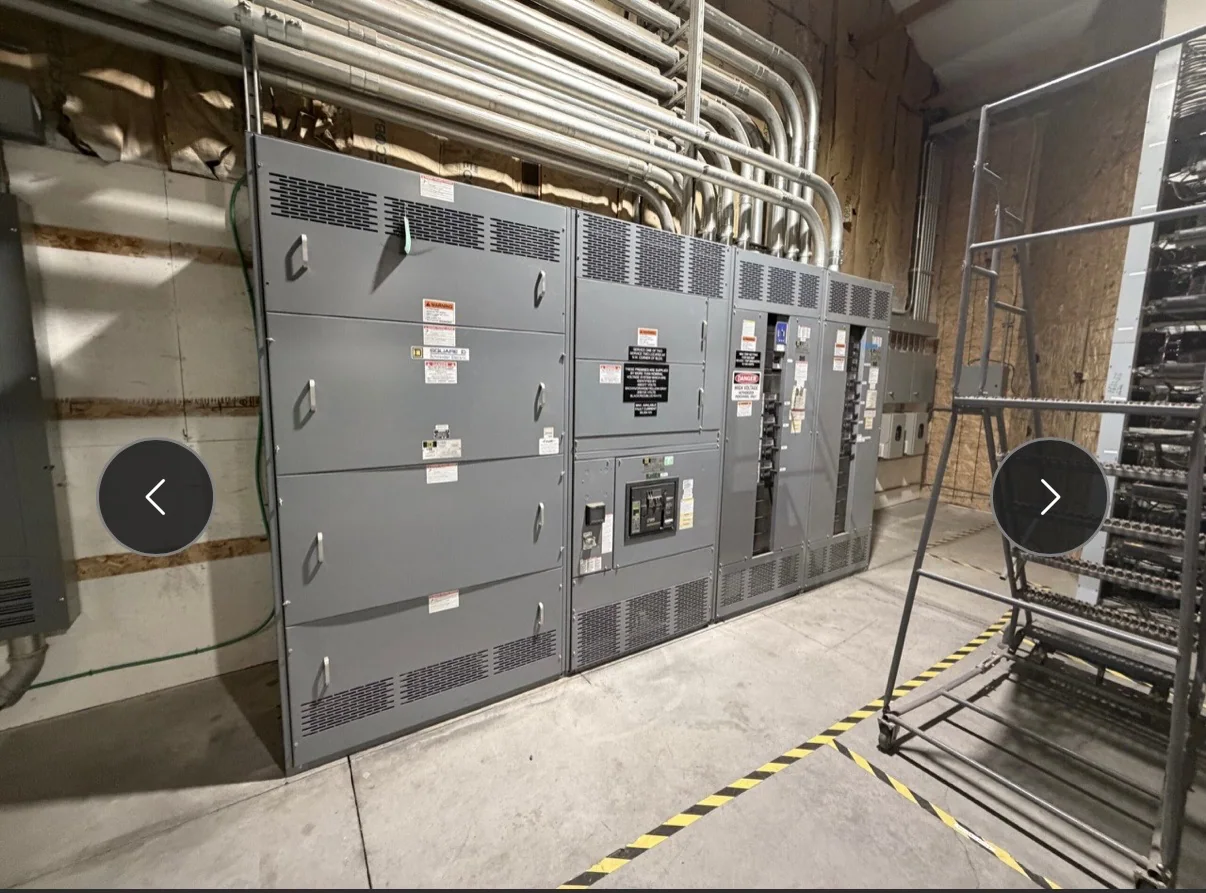
Start with the busway identity, not a guessed fit
For a surplus busway evaluation in Westerville, the useful starting point is a legible record of what is actually present. Existing equipment may be associated with a tenant relocation, a building changeover, a decommissioned data center, or a shut-down power plant; the pickup site could be in Franklin or Delaware County, and address and ownership remain facts to confirm. Describe each run by its manufacturer, series, visible nameplate wording, voltage class, ampere rating and phase or conductor information when documented. The buyer considers all voltage classes, but appearance alone does not establish voltage, capacity, compatibility or condition.
Separate straight lengths from elbows, tees, end feeds, joints and tap-off units. A tap box with a breaker or fused device is not interchangeable with an empty fitting simply because the housings look similar. Do not combine components from different series into one assumed system. Safe exterior photographs of labels, ends and stored packaging can help; the seller does not need to open equipment, operate anything, dismantle a run or test an energized system.
Resolve the tenant-relocation boundary
A tenant move can create the hardest documentation problem: some busway may be saleable while another section still supplies retained rooms, shared services or a landlord-controlled electrical path. Mark the proposed lot by run and location rather than saying “all busway in the electrical room.” Identify which straight sections, fittings, tap-offs and supports are released, which remain in place, and which ownership boundary is still unknown. Existing one-lines, reflected ceiling plans, asset lists, relocation drawings or removal notes are useful if available, but they should be treated as records to review, not proof that every labeled component is included.
Hypothetical example: a tenant relocation leaves a documented overhead run above a former production area, while a branch continues toward an occupied suite. The first run might be proposed for sale, but the retained branch and its feed path must be excluded until the authorized owner confirms the boundary. Record the release window and the site contact who can grant access; neither should be inferred from a moving date or an old drawing.
Make the lot complete enough to value
Count pieces by type and by system. A practical inventory might list twelve straight lengths with their documented lengths, two elbows, one joint kit, three tap-off units, end closures, hanger hardware and any loose covers or cartons. Note whether each item is installed, palletized, boxed, tagged or stored separately. If a tap-off’s rating, device type or relationship to a run is unknown, say so instead of assigning a rating from its size. Include loose joint kits only when their association is documented; otherwise list them as unverified accessories.
Completeness affects whether a lot can be evaluated as a coherent system or only as mixed surplus. Helpful questions include: Is there a current schedule of runs? Are straight-section lengths measured from records or estimated? Are joints, covers, hangers and end feeds included? Were any pieces substituted, cut, repaired or relocated? Are spare tap-offs from the same manufacturer and series, or merely stored nearby? These answers are more useful than a single total-footage figure.
Describe condition without unsafe inspection
Condition notes should distinguish observed exterior facts from assumptions. Report dents, bent housings, corrosion, water staining, missing covers, crushed packaging, label damage and evidence of prolonged storage. For installed busway, note accessible exterior condition and the surrounding clearance only if that information is already available. Do not ask the seller to remove covers, expose conductors, verify continuity or operate tap-offs. A qualified, authorized team must establish safe conditions and handle any required disconnection; no seller testing is required.
Documentation can also explain history: removed from a data center, held as plant spare, recovered during a shutdown, or retained after a tenant change. Those descriptions do not guarantee reuse. The buyer can weigh known history, storage protection, completeness and the uncertainty around unseen areas without treating an untested item as defective or service-ready.
What shapes the offer and release plan
Valuation may reflect documented voltage and ampere information, manufacturer and series consistency, usable straight-run lengths, the number and type of fittings, included tap-offs, joint hardware, physical condition, packaging and the clarity of the lot boundary. A mixed lot with unknown compatibility may be valued differently from a matched, well-recorded system. The location in Westerville matters for planning, but it does not establish a price, demand, ownership or pickup date.
After agreement, payment is made upfront as agreed; the seller is not expected to fund testing or removal. The buyer handles qualified disconnection, crane needs, rigging, loading, freight and hauling. Access approvals still require coordination: identify the landlord or facility representative, security rules, loading restrictions, outage or release authorization, and the window when the retained power paths are no longer needed. Coordinating those approvals does not shift removal costs or physical handling to the seller.
A useful Westerville submission
Send the available ownership or release documentation, a component schedule, nameplate transcriptions, safe exterior photos and a simple location map showing each run or storage area. Include the release date or window, the authorized access contact, known retained power paths and any restrictions on trucks, cranes or loading areas. If facts are unknown, label them unknown. A concise submission lets the buyer separate an overhead tenant system from retained building infrastructure and plan a safe review without asking anyone to touch energized equipment.