Start with the rating that is actually documented
A 1,200-amp description helps only when records show which component carries that rating. It may refer to a main bus, switch, through-feed assembly, or another part of the pad-mounted switchgear. Do not assume every switch, fuse position, connector, or cable compartment is rated 1,200 amps because the enclosure is described that way. Begin with a legible exterior nameplate, schedule, one-line drawing, or equipment list identifying the assembly. Unknown values should stay unknown.
This route considers equipment at any voltage class when the documented equipment and release details support evaluation. Record full voltage wording, continuous-current wording, interrupting rating, separately. Continuous current, interrupting rating, and trip settings are different facts. A breaker’s interrupting capability does not establish the enclosure-bus rating, and a trip setting does not prove the device nameplate rating. Photos should be limited to safe exterior labels and access conditions.
Describe the complete outdoor equipment lot
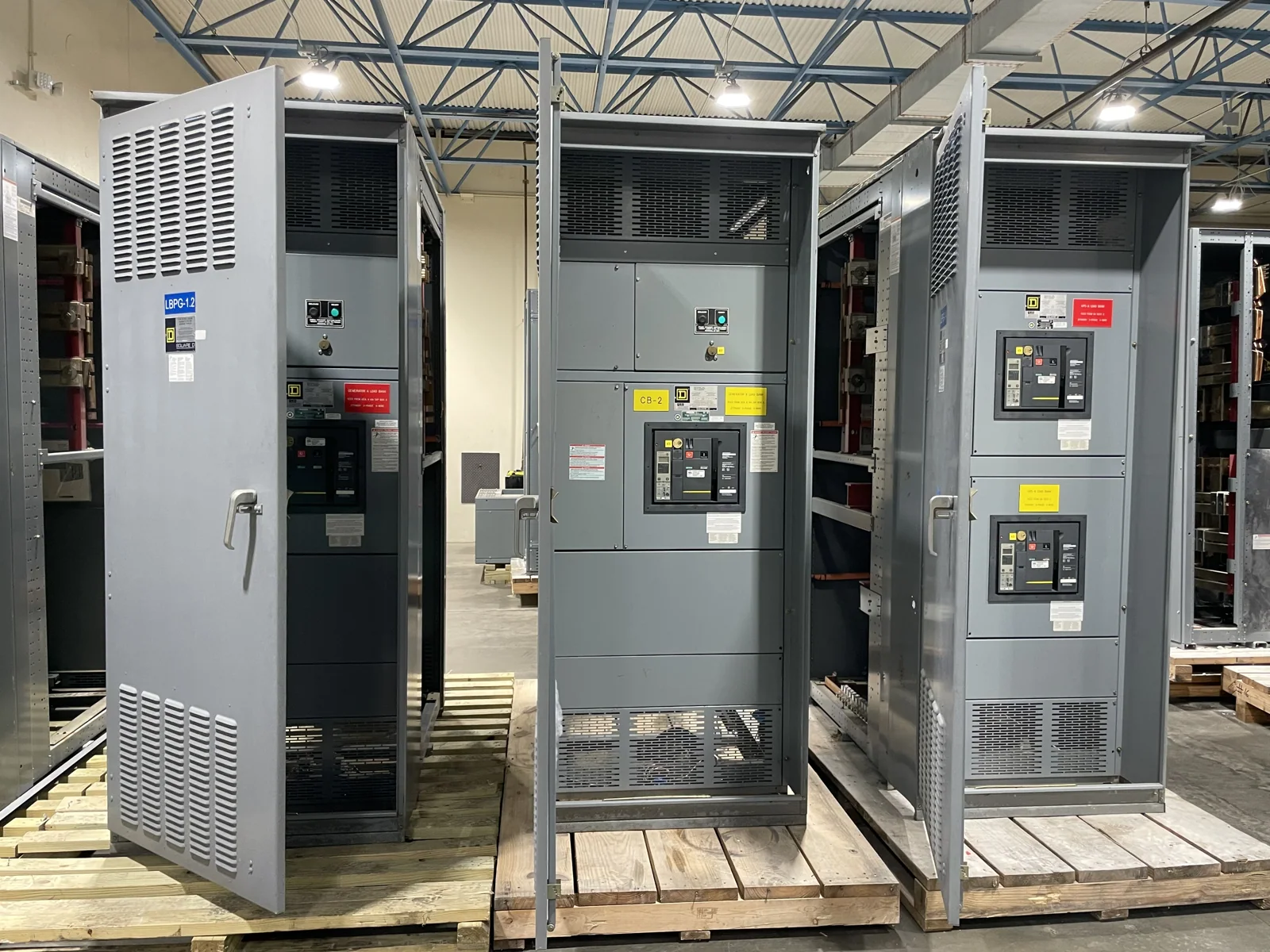
Identify the outdoor enclosure first, then list switching devices inside or associated with it only from available documentation. Include enclosure identification, compartments, switch or interrupter designations, fuse positions, operating mechanisms, cable-entry sections, control cabinets, and separately stored devices. Note whether covers, barriers, handles, nameplates, lugs, or accessory cabinets are present, missing, or unknown. Do not open a compartment to find out.
Hypothetical example: An owner’s schedule describes one pad-mounted enclosure with a 1,200-amp main switch, two feeder positions, and a separately stored device marked for one position. Preserve those distinctions: one documented 1,200-amp component, two feeder positions with their own ratings if available, and one loose device whose association is documented but condition is unknown. Do not report four 1,200-amp switches without evidence.
Confirm ownership before discussing release
Outdoor switchgear may sit near a service entrance while belonging to a customer, utility, landlord, contractor, or another asset owner. Location alone proves nothing. Identify the legal owner or authorized release contact, and note whether an easement, service agreement, lease boundary, insurance requirement, or environmental review affects the lot. If ownership is disputed or undocumented, call it a material unknown.
Describe known restrictions such as active service nearby, fencing, controlled gates, limited truck approach, overhead obstructions, soft ground, restricted hours, or escort requirements. These details support safe-release coordination. Coordination of approvals does not shift removal costs to the seller. The buyer handles qualified disconnects, crane arrangements, rigging, loading, freight, and hauling.
Condition and completeness affect evaluation
Exterior condition can provide context without operating equipment. Report visible corrosion, impact damage, missing paint, bent doors, standing water, exterior-visible cracked insulators, fluid staining, contamination, fire damage, or long outdoor storage. State whether the enclosure is installed, staged, or loose, and whether skids, lifting points, keys, barriers, or documented accessories are present. Do not infer internal condition from a clean exterior or claim functionality without qualified evaluation.
Completeness is more than counting boxes. A lot may evaluate differently when its documented switching devices, covers, operating parts, fuse hardware, controls, and records remain together. Tag separately stored items by their known association. A missing label or unmatched device reduces certainty even when the enclosure appears intact.
Factors in a potential offer
A potential offer may reflect verified rating boundaries, manufacturer and series information, voltage class, device count, completeness, visible condition, ownership clarity, and the complexity of safe handling. Freight dimensions, recorded weight, lifting access, staging space, route restrictions, and whether the lot can be released in one coordinated pickup also matter. A 1,200-amp label alone does not determine value,; a photograph does not establish price.
The business buys equipment rather than selling it. After reviewing the equipment and release conditions, the buyer can make a cash offer; once the seller accepts and the sale is agreed, payment is made upfront before the agreed pickup according to the transaction terms. The seller need not test, energize, operate, dismantle, or prepare the switchgear. Mark technical or ownership unknowns for follow-up.
Plan staging, access, and freight together
Explain where the enclosure sits, whether it is on a pad, and what a qualified removal team will encounter on approach. Include gate or escort procedures, approval contacts, loading-hour limits, crane or trailer clearance concerns, and a safe staging area if known. These are coordination details. The buyer arranges qualified isolation and disconnect work, rigging, crane service, loading, hauling, and freight.
For a decommissioned data center or shut-down power plant, define the release boundary carefully. Pad-mounted switchgear may be surplus while nearby service equipment, cables, transformers, or protective systems remain assigned elsewhere. Hypothetical example: If two outdoor enclosures sit on separate pads, list each location, owner, release date, and access condition separately rather than combining them into one 1,200-amp lot.
Questions to include with an evaluation request
- Which exact component bears the 1,200-amp rating, and where is it documented?
- What are the full voltage, continuous-current, interrupting, and device ratings?
- Which enclosure, switches, fuse positions, covers, accessories, and stored devices are included?
- Who owns the equipment, and who may approve release?
- What exterior damage, contamination, fluid issue, or missing identification is known?
- Is it installed, staged, or stored, and what access restrictions or approvals apply?
- What release date and loading coordination window are realistic?
Share existing schedules and safe exterior label photographs. Leave unreadable details blank. Qualified, authorized personnel establish safe conditions and handle isolation and removal; sellers should not touch energized equipment or perform tests. Clear boundaries let the buyer evaluate the 1,200-amp pad-mounted switchgear lot rather than an assumption based on its enclosure.