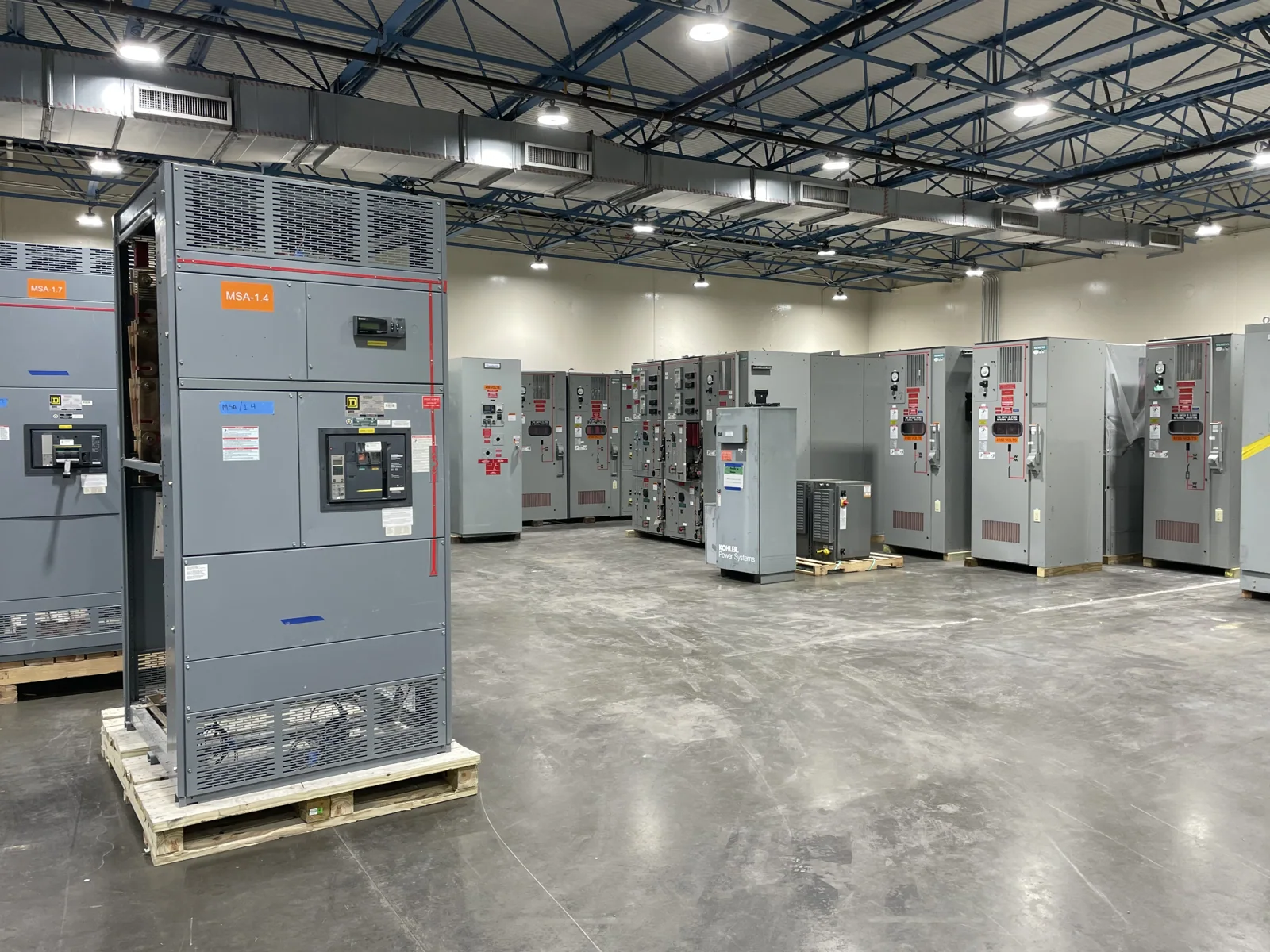
Define the physical lot before describing its value
When an Ohio seller presents an ABB-marked unit substation lot, the first question is not whether every visible cabinet belongs in one package. It is what physical boundary is actually available for release. A unit substation may be arranged as a transformer, primary switching section, secondary distribution section, and connecting or transition sections. Those pieces can be adjacent, stored separately, or partly retained for an operating facility. List each section rather than calling the entire room a lot.
ABB should be treated as a marking to verify on each item, not as proof of affiliation, authorization, model compatibility, price, or condition. Record the manufacturer wording visible on nameplates, doors, labels, drawings, and shipping tags. If a plate is unreadable, say so. Do not infer a voltage class from enclosure size or from a nearby device. Capture primary voltage, secondary voltage, frequency, transformer kVA where documented, primary current, secondary bus or device current, and interrupting information as separate fields. Primary and secondary nameplate ratings should never be blended into one shorthand rating.
Identification and documentation that makes a lot understandable
Existing records often explain relationships that an exterior photograph cannot. Useful material may include one-line diagrams, equipment schedules, room layouts, transformer nameplate images, shipping records, prior removal lists, and a written ownership or release statement. A drawing can show whether switching and distribution were supplied as connected sections, while a storage list may identify loose breakers, fuses, bus connectors, control cabinets, or transition pieces that are no longer installed.
Use safe exterior photos only: full views of each cabinet or tank, readable labels photographed from a safe position, doors and covers as found, skid or pallet markings, and the surrounding access path. Do not open compartments, operate handles, remove covers, touch energized equipment, dismantle anything, or test it for the evaluation. A qualified, authorized team must establish safe conditions and handle isolation and disconnection. The seller is not required to test the equipment.
Completeness and condition without assumptions
A complete lot description separates installed sections from loose components. For the transformer, note whether bushings, lifting points, radiators, gauges, accessories, fluid records, and shipping supports are present as documented. For switching, list the section count, visible device identifiers, shutters or covers as observed, and any stored operating or protective devices. For distribution, identify bus or feeder sections, metering compartments, transition sections, and known missing panels. Do not call a component compatible merely because it has an ABB marking.
Condition reporting should be factual and limited to what can be safely observed. State whether equipment is indoors or outdoors, protected or exposed, packaged or loose, and whether there is visible corrosion, impact, water entry, oil staining, cracked insulation, pest damage, or missing hardware. Disclose known fluid concerns, environmental records, leaks, or an unknown fluid status without guessing the cause. A clean exterior does not establish internal condition, and an old date code does not by itself establish failure.
What can affect a potential offer
Valuation depends on a defined, transferable lot rather than on a brand name alone. Documented ratings, identifiable sections, matching records, complete accessories, credible ownership, and a practical release window can improve clarity. Missing nameplates, uncertain section relationships, mixed storage, unverified loose devices, fluid concerns, damage, and a boundary that includes equipment still needed by the facility add uncertainty. Voltage class, dimensions, weight, lifting points, packaging, and the distance and complexity of the freight route also affect the evaluation.
Hypothetical example: an Ohio shutdown may release one ABB-marked transformer, two primary switching sections, one secondary distribution section, and a separately stored group of devices. That description is only a starting inventory. The buyer would still need the documented ratings, section identifiers, fluid information, ownership confirmation, and a statement of which loose devices belong to the same lot. It would be inaccurate to promise a price or compatibility before those facts are reconciled.
Worked inventory checklist for the seller
- Transformer: quantity, visible manufacturer marking, primary and secondary nameplate ratings, documented kVA, approximate dimensions, fluid status, and known concerns.
- Switching: each section or enclosure, visible device labels, documented voltage and current, removable devices stored with it, and known missing covers or hardware.
- Distribution: main and feeder sections, bus or connection sections, metering or control compartments, transition pieces, and retained boundaries.
- Loose components: breakers, fuses, connectors, relays, supports, cabinets, or manuals, each listed separately with its storage location and any uncertain association.
- Release record: owner or authorized contact, equipment that must remain, approval requirements, earliest coordinated access window, and any site rules.
Access, safe release, and payment coordination
Share the access facts that define the move without taking on removal work. Useful details include doorway and gate dimensions, floor level, loading surface, overhead obstructions, turning limits, security procedures, outage or isolation approvals, and contact information for the authorized site representative. Treat these as coordination items; the buyer handles the crane, qualified disconnects, rigging, loading, freight, and hauling. The seller should not dismantle or prepare energized equipment.
After the lot, ownership, condition, and release terms are understood, the buyer can review the lot and make a cash offer; once the seller accepts and the sale is agreed, payment is made upfront before the agreed pickup, subject to the transaction terms. The seller’s role is to provide accurate records, identify the physical boundary, disclose unknowns, and coordinate authorized access. For an evaluation, begin with the inventory checklist and safe exterior photos, and label every fact that remains unknown.