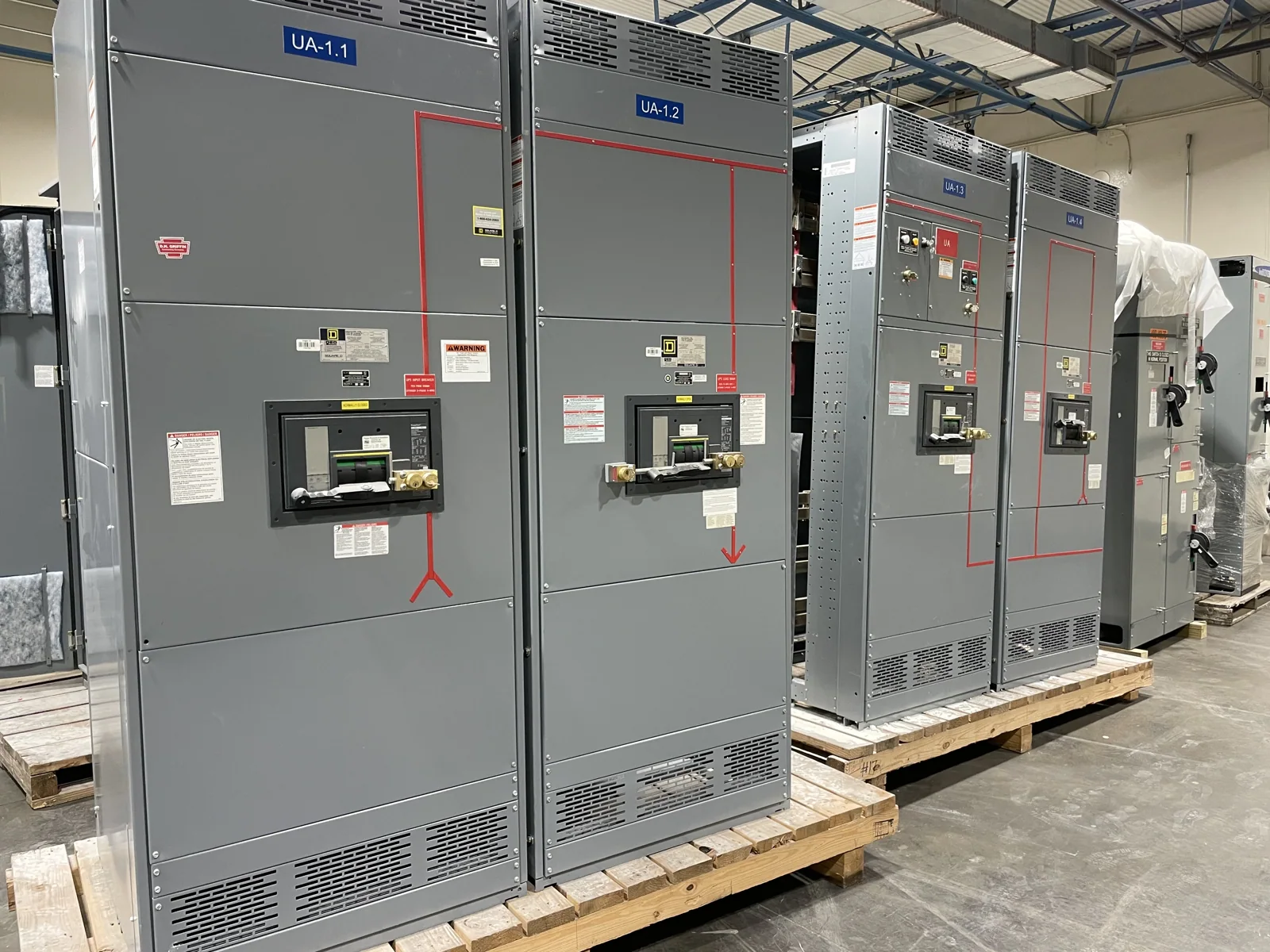
Start with the component that actually carries the 2,000-amp mark
A 2,000-amp label on a lineup does not automatically make every breaker in that lineup a 2,000-amp circuit breaker. The useful starting point is the individual device: its nameplate, catalog or frame marking, and documented position. A main breaker, drawout unit, feeder breaker, spare device, or other component may each have different electrical information. Share the wording that is already visible on safe exterior labels and existing schedules rather than estimating from enclosure size or bus appearance.
For an evaluation, identify the manufacturer as shown, the catalog or frame designation, quantity, voltage wording, and visible interrupting or trip information. All voltage classes can be considered; voltage should remain as documented, including an unknown value. A 2,000-amp continuous-current designation, an interrupting rating, and a trip setting describe different things. A bus rating belongs to the bus unless records establish that a particular device has the same rating.
Resolve the installed-versus-stored access problem
One of the most important distinctions is whether a breaker is still installed in an operating lineup or is a separately stored spare. List those groups separately. For an installed device, record the lineup or section identifier, labeled position, and whether the records describe it as main, feeder, tie, or another function. For a stored device, record its storage location, exterior identification, quantity, and any tag that links it to a section. If that connection is not documented, call it unknown instead of assigning the spare to a position.
Hypothetical inventory: a decommissioned data center may have one documented 2,000-amp main breaker in a lineup, one 2,000-amp feeder breaker in another section, and two boxed spare devices with similar frame markings. The inventory should show four separate lines, preserve the label text for each, and state whether the boxes, hardware, trip units, shutters, racking accessories, or instructions are present. It should not combine them into “four matching breakers” unless the records support that conclusion.
Document completeness without opening or testing anything
Useful records can include equipment schedules, one-line diagrams, lineup drawings, asset registers, decommissioning lists, purchase records, and storage notes. Existing documentation helps establish whether a device belongs to the sale and which accessories were supplied. Safe exterior photographs may show labels, cabinet faces, crates, corrosion, impact marks, missing covers, or water exposure. Sellers do not need to open, operate, dismantle, energize, or test a breaker.
Describe what is visibly present and what is absent. A breaker may be offered with a trip unit, auxiliary contacts, racking handle, lifting hardware, compartment hardware, or protective packaging, but those inclusions should be confirmed rather than assumed. Note loose parts in a separate count. If the label is unreadable, a schedule conflicts with the exterior marking, or an accessory cannot be matched, preserve that uncertainty for review.
Condition, ownership, and value factors
Condition review begins with documented history and visible exterior evidence, not a seller-performed test. Mention whether the equipment came from a shut-down power plant, decommissioned data center, warehouse, or another setting only when that history is known. Record prolonged storage, moisture, contamination, paint damage, cracked insulation visible from outside, missing doors, bent hardware, or incomplete packaging. A clean exterior is not proof of operating condition, and an unknown service history should remain unknown.
Potential offer considerations include verified 2,000-amp identity, documented voltage and interrupting information, manufacturer and catalog traceability, quantity, completeness, condition, storage environment, and whether stored devices can be tied to a lineup. Confirm that the seller has authority to transfer the equipment and identify any landlord, utility, lender, contractor, or shutdown-project approval. The buyer does not assume that an adjacent bus, cubicle, control wiring, or retained breaker is included without a clear boundary.
Coordinate release, staging, and freight safely
Access is a coordination issue, especially when a 2,000-amp breaker remains in a restricted electrical room or when a plant shutdown has multiple release stages. Share the authorized contact, approval requirements, release window, loading restrictions, and known route from the equipment to the loading point. A seller should not disconnect or move anything merely to prepare an offer. Qualified, authorized personnel establish safe conditions and handle isolation and removal.
After agreement, the buyer handles qualified disconnects, crane needs, rigging, loading, freight, and hauling. The seller’s role is to provide ownership and access information and coordinate site approvals; removal costs and handling responsibilities should not be shifted to the seller. Staging details matter: note whether devices are loose, crated, on pallets, behind controlled doors, or subject to facility scheduling. Weight, dimensions, lifting points, dock limits, and route clearances should come from records or site coordination, never guesses.
Questions to include with an Ohio inventory
- Which exact component bears the 2,000-amp marking, and what do its catalog, frame, voltage, interrupting, and trip labels say?
- How many devices are installed, how many are stored, and which associations are documented versus unknown?
- What accessories, compartment hardware, crates, drawings, and schedules are included or missing?
- Who owns each device, who can authorize release, and are any sections retained for service?
- What visible condition issues, storage history, access approvals, loading limits, and release stages should be coordinated?
Once the lot boundary and documentation are clear enough for an evaluation, a cash offer can be discussed. After agreement, payment is made upfront, and the buyer coordinates the qualified removal and transportation work. No seller testing is required.