Start with the release decision
Switchgear from a data-center decommissioning can represent a complete electrical package, a partial lineup, or equipment that cannot yet be released. First establish whether the owner has authority to sell it and whether migration has preserved every required redundant path. Treat the facility and shutdown as hypothetical unless records establish otherwise. Identify the owner, tenant, landlord, operator, and approval parties before a buyer receives equipment.
Do not assume that a room being labeled “decommissioned” means every feeder is available. An A path, B path, bypass, generator tie, or temporary source may remain necessary until workloads migrate. Mark each lineup as available, retained, or unknown. The release boundary must be clear before an offer.
Identify rooms, lineups, and devices
Build a room-by-room inventory
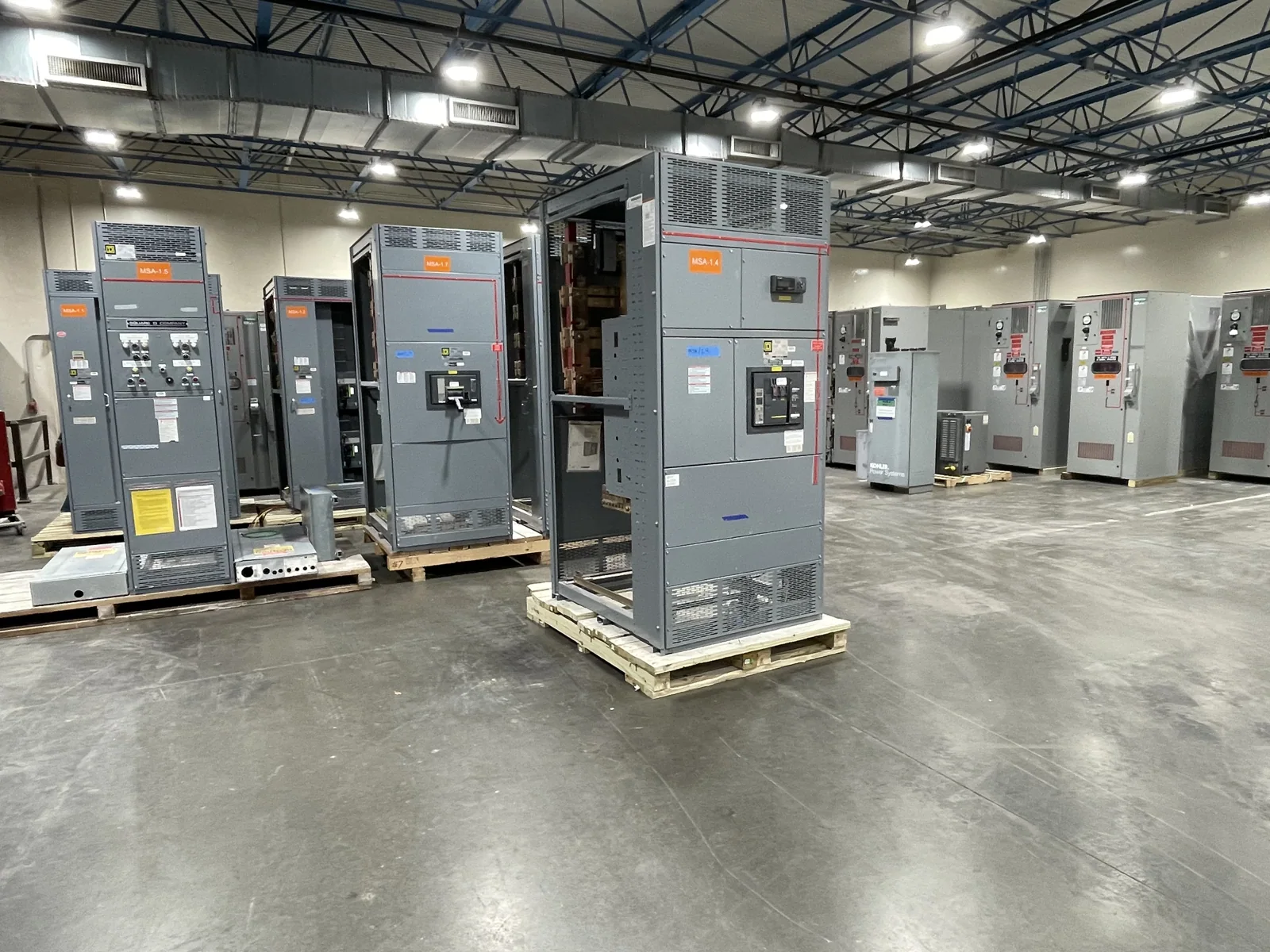
Begin with the electrical-room name or internal designation, then list each distribution lineup in that room. Record incoming sections, main sections, tie sections, feeder sections, and any bypass or transfer equipment shown in existing schedules. Count the vertical sections and note which section labels are visible. Separately list removable breakers, stored breakers, relays, trip units, control power components, and spare parts. A loose device should not be assigned to a lineup merely because its voltage class appears similar.
Use exact nameplate wording for manufacturer, assembly designation, voltage, continuous current, interrupting information, frequency, and serial or section identifiers. Do not infer a rating from enclosure size, brand, or a photograph. A lineup rating, bus rating, and individual breaker rating answer different questions. If a field is unreadable or undocumented, label it unknown.
Protect sensitive information
Before sharing drawings, one-lines, photographs, or schedules, remove security details, access codes, network diagrams, camera coverage, customer names, and other sensitive operational information. A cropped nameplate photo may help without exposing a protected room layout. Records do not authorize anyone to operate a device, open a compartment, or enter an energized area.
Check completeness and condition without testing
A strong lot description connects each released section to its visible devices and stored accessories. Note missing doors, covers, shutters, hardware, control fuses, wiring, keys, shipping braces, and breaker compartments only from safe exterior observation or existing documentation. Describe whether equipment is installed, staged, palletized, or stored separately. Include known water intrusion, corrosion, impact, contamination, fire exposure, rodent damage, or environmental concerns. Disclose what is known; do not sample or disturb residue.
No seller-operated test is required. Never open, operate, dismantle, touch, or approach energized equipment to improve an evaluation. Qualified, authorized personnel must establish safe conditions and handle disconnection. Distinguish observed exterior condition from assumptions about internal operation or performance.
Example inventory and offer factors
Hypothetical example: an Ohio facility’s migration plan releases one indoor lineup from Electrical Room 2 after the owner confirms that the retained redundant lineup remains in service. The proposed lot might contain six documented sections: one incoming section, one main section, a tie section, and three feeder sections; four removable breakers installed in those sections; two separately stored breakers with uncertain association; and a folder of redacted schedules. The example is not a claim about an existing project. Its value is the separation of confirmed items from items requiring review.
- Offer consideration may include documented voltage and current, manufacturer and configuration, section count, breaker quantities, and whether devices are matched to positions.
- Completeness matters: covers, doors, bus connections, control components, spare devices, labels, and original documentation can affect evaluation.
- Condition, storage environment, contamination disclosure, age evidence, and visible damage help distinguish a preserved lot from an incomplete or exposed one.
- Commercial factors include ownership clarity, the authorized release date, whether the buyer can acquire the lot together, and the cost and complexity of handling large sections.
These factors support an evaluation, not a guaranteed price; an assessment may change when documentation, ownership, or the lot boundary changes.
Coordinate milestones, access, and release
Share milestones affecting availability: migration completion, outage approval, landlord or tenant sign-off, room access windows, and the authorized release date. If a tenant owns removable devices while the building owner controls the lineup, identify that boundary in writing. Note any utility, lender, insurer, or other stakeholder approval; possession alone is not proof of ownership.
Access planning is coordination, not a request for the seller to perform removal. Provide the authorized site contact, access rules, escort needs, loading-hour limits, floor or doorway restrictions, elevator information, section dimensions from records, and any known rigging constraints. The buyer handles qualified disconnection, crane arrangements, rigging, loading, freight, and hauling. The seller identifies the lot, grants approved access, and communicates site requirements; do not move equipment for pickup.
Questions to answer before release
- Who owns each lineup, breaker, spare, drawing set, and stored accessory?
- Which incoming, feeder, tie, bypass, or redundant paths must remain available until migration is complete?
- What voltage, current, manufacturer, section identifiers, and device markings are documented rather than inferred?
- Which items are confirmed in the lot, which are retained, and which remain unknown?
- Are there known environmental issues, water events, corrosion, contamination, or access hazards to disclose?
- What approvals and milestone date establish the authorized release?
With those answers, the seller can present a defensible, privacy-conscious inventory. After agreement, payment is made upfront and the buyer coordinates the qualified removal and transport plan. Keep safety and authority ahead of speed: a clean release is one that preserves required power until migration is complete and transfers only equipment the seller is authorized to provide.