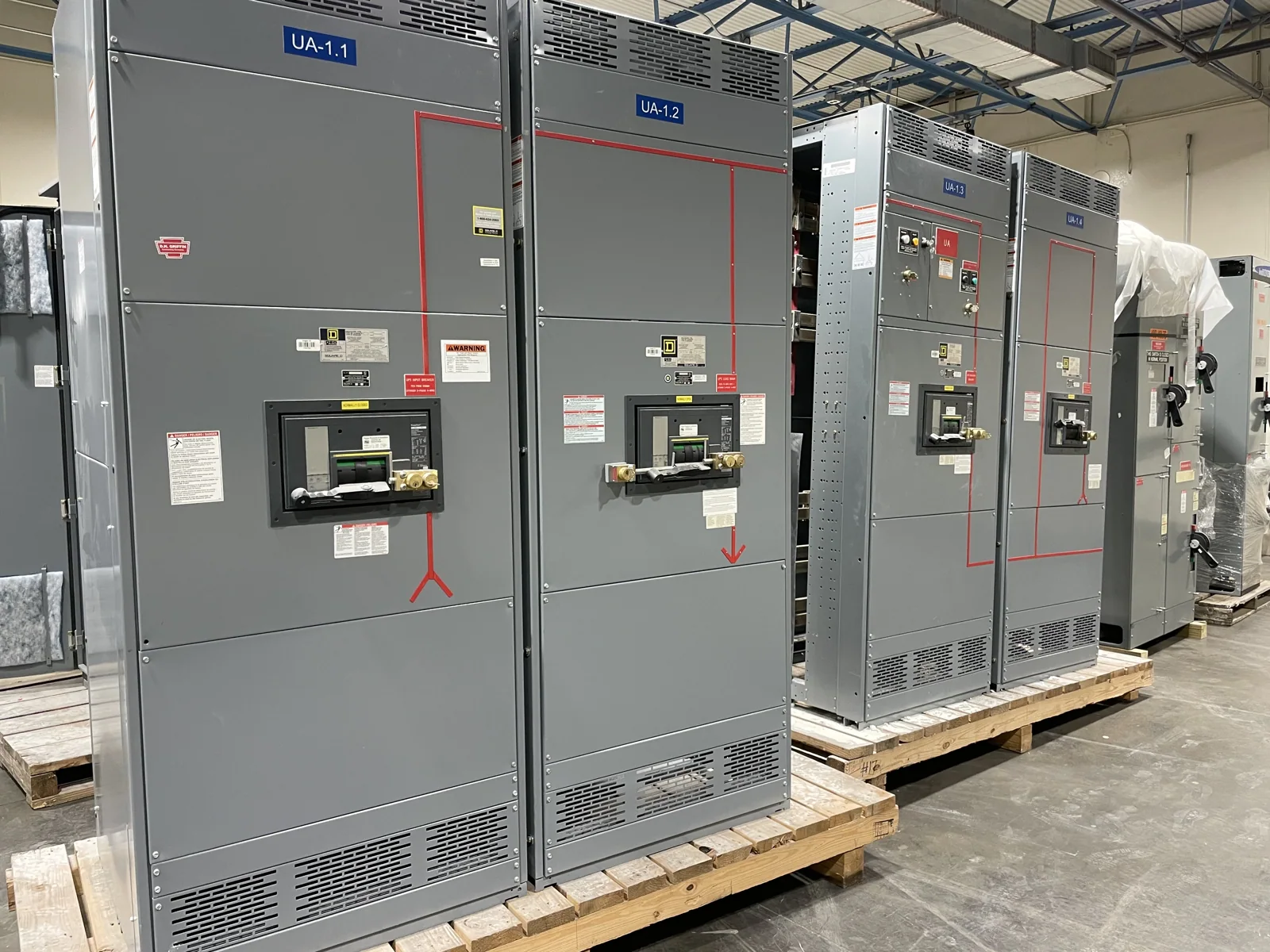
Start with the busway identity, not the county label
For a surplus busway evaluation in Portage County, the useful starting point is the equipment record, not an assumption about where it sits. Existing records identify Ravenna as the county seat, but the actual pickup site may be elsewhere in the county. Share the facility description, ownership authority, and any release contact along with the equipment list. The buyer considers busway across voltage classes, so a low-voltage appearance or a familiar brand name is not enough to establish what the lot is.
Describe busway by its parts and labels. Separate straight lengths, elbows, joints, tap-off units, end closures, reducers, hangers, and other accessories. If a nameplate or exterior label is visible, record the manufacturer, series, voltage, ampere rating, phase or conductor information, and catalog or section identifier exactly as shown. Do not infer a rating from physical size or assume an elbow or tap-off from another series will fit.
Group a stored inventory by labeled series
Hypothetical example: a stored inventory might contain 18 straight sections marked with one series, four elbows with partial labels, six tap-off units in separate cartons, and a pallet of unidentified joints. The sound way to present that lot is to group the 18 labeled sections together, list the elbows separately with their visible markings, and call the joints unidentified until records establish an association. It would be misleading to combine every component into one interchangeable system.
For each group, provide quantities, documented section lengths, packaging status, and storage location. Note whether hangers, joint covers, end caps, splice hardware, or tap-off covers are included or unknown. Drawings, bills of material, removal lists, or installation schedules can connect components without asking anyone to open equipment or prove compatibility.
Check completeness without disturbing the equipment
Completeness affects the usefulness and valuation of a busway lot. A run with straight sections but no documented joints may have limited value as a complete system, while a smaller group with matching elbows, tap-offs, closures, and hardware may be easier to evaluate. Describe missing pieces plainly. “Not found” is more useful than guessing that a carton belongs to a particular run.
Include the number of cartons, pallets, racks, or loose pieces, the label on each storage unit, and whether the inventory came from one project or several. Compare documented section counts with visible inventory and mark discrepancies unknown. Do not repackage, rearrange, dismantle, or open equipment. Safe exterior photos of labels, ends, cartons, and damage are sufficient initially.
Describe condition and documentation honestly
Condition notes should distinguish storage wear from facts that remain unverified. Report crushed packaging, bent housings, corrosion, water staining, missing covers, dirt, impact marks, or signs that hardware is loose or incomplete when those conditions are visible. State whether pieces are indoors, weather-exposed, elevated, blocked, or protected by original packaging. Avoid calling busway tested, serviceable, or ready for reuse unless existing documentation supports that description.
Useful records include nameplate photographs, packing lists, ownership records, drawings, removal documentation, maintenance files, and a list of known missing components. The buyer does not require testing. Do not open, operate, touch, energize, dismantle, or disconnect anything; a qualified, authorized team must establish safe conditions and handle disconnection.
What can influence an offer
Valuation can reflect more than the number of straight sections. Matching series and documented ratings, a coherent set of fittings, identifiable tap-off units, complete visible hardware, dry storage, and credible ownership records can all make a lot easier to evaluate. Conversely, mixed series, unidentified cartons, missing joints, damaged housings, uncertain ownership, environmental concerns, or an incomplete release boundary may reduce confidence.
All voltage classes are considered, but the buyer must evaluate the actual documentation rather than assign a class from appearance. After reviewing the lot, the buyer can make a cash offer; once the seller accepts and the transaction terms are agreed, payment is made upfront before the agreed pickup. The seller does not need to provide a test report. Assessment depends on the inventory, condition, documentation, access, and transportation requirements, not a presumed Portage County market price.
Coordinate access and freight at the real pickup site
Once ownership and scope are clear, identify the actual site, storage area, access approvals, contact person, available hours, floor or ground conditions, doorway and overhead constraints, and any building or security rules. These are coordination details, not a request for the seller to perform removal work. The buyer handles crane needs, qualified disconnects, rigging, loading, freight, and hauling. The seller should only identify the authorized people and approvals needed for that work.
Busway can be long, heavy, awkward, or vulnerable at exposed ends. Mention the route to loading, any lift or dock, and vehicle-positioning restrictions. Mark unknown dimensions or weights unknown rather than estimating. A clear lot boundary prevents components being left behind or adjacent property being included.
Questions to include with the inventory
- What is the actual pickup location, and who can authorize release there?
- Which straight lengths, elbows, joints, tap-off units, closures, and hangers carry the same documented series?
- What voltage, ampere, manufacturer, and series information is visible on each group?
- Are any pieces from different systems, or are component relationships unknown?
- What records show ownership, prior use, storage history, or missing components?
- Are there access approvals, loading restrictions, or active equipment boundaries that must be coordinated?
Send available records and safe exterior photos, identify unknowns directly, and let the authorized field team manage safe release and removal. This supports evaluation of the actual Portage County lot rather than a generic parts count.